


Most organizations have moved past the question of whether they need to assess their workforce’s skills. The harder question is which tool to use. Feature lists blur together. Demos all look polished. And the wrong choice means months of effort producing data nobody trusts. The World Economic Forum’s 2025 Future of Jobs Report found that 63% of employers rank skill gaps as the single biggest barrier to business transformation. The tool you choose to identify and measure those gaps is not an admin decision. It is a strategic one.
If you have already explored how to effectively approach your employees’ skills assessment, you know that assessment methodology matters. The structured subjective approach, combining self-assessment and supervisor validation within a curated, role-relevant framework, gives you the data quality that purely subjective or purely objective methods cannot. But methodology alone does not produce results. You need a tool built to support it.
The real cost of choosing the wrong tool
The cost of a bad tool choice goes well beyond wasted licensing fees. When a tool produces unreliable data, every downstream decision it touches is compromised: training budgets aimed at the wrong gaps, project teams staffed on assumptions, promotions based on perception rather than verified capability.
This is not a theoretical risk. According to Gartner’s 2025 CIO Talent Planning Survey, nine out of ten organizations have adopted or plan to adopt skills-based talent management. But the biggest barriers to making it work are HR capacity and the ability to collect and maintain accurate, current skills data. Adoption is near-universal. Execution is where most organizations stall. And the tool is at the center of execution.
Your assessment methodology should shape your shortlist
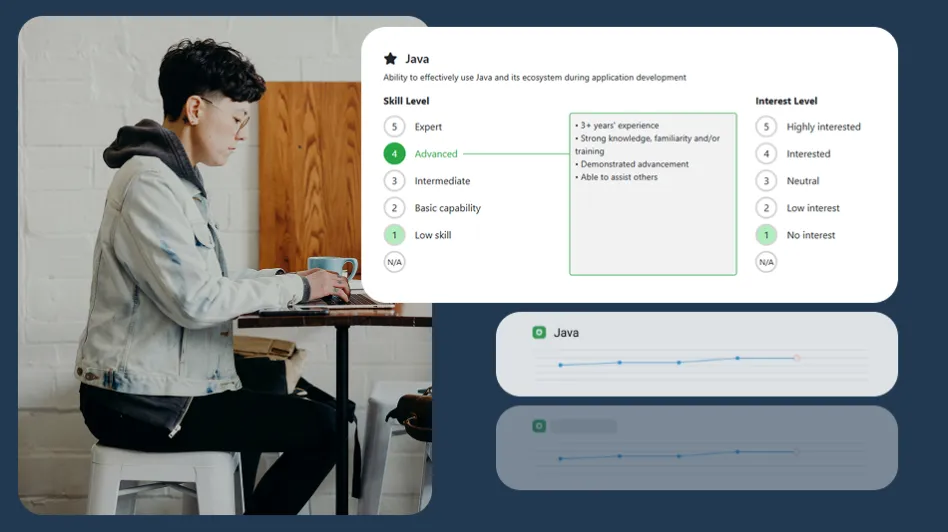
Before comparing features, start with what your assessment methodology actually requires. If you have adopted a structured subjective approach, your tool needs to support several specific capabilities: organization-authored assessments tied to your objectives, a curated and structured list of skills assigned by job function, a standardized numeric rating scheme, defined rating criteria that remove ambiguity, employee self-assessment, and supervisor validation that verifies and calibrates those self-reports.
These are not nice-to-haves. They are the structural controls that produce data you can trust. A tool that skips any of them will give you volume without accuracy. And according to the Skills in Practice Report 2026, the organizations extracting real value from skills data average 41.4% supervisor-validated assessments, with the most mature reaching 97%. If your tool does not make supervisor validation easy and visible, that number will stay at zero.
When evaluating platforms, map your methodology’s requirements against the tool’s capabilities before you look at anything else. If it cannot support how you assess, the rest of the feature list is irrelevant. For organizations still building a structured skills taxonomy, this alignment is especially critical. The tool and the taxonomy need to work together from day one.
Five capabilities that set the best skill assessment software apart
Not all skills assessment tools are built the same way, even if their marketing says otherwise. These five capabilities consistently separate tools that produce actionable data from those that produce shelf-ware.

Role-relevant skills architectures, not generic checklists
The tool should support dense, curated skill libraries mapped to specific roles. Not a cloud of 20,000 uncontextualized terms. Not a flat list of soft skills. The Skills in Practice Report 2026 found that mature enterprise deployments average 89 skills per role, and 94.4% of tracked skills are hard, technical, and role-specific. That is not vague capability mapping. That is a detailed model of what your workforce actually does.
Look for a tool that lets you curate your own taxonomy, structure skills by category and hierarchy, and assign them by role. If the tool only offers pre-built, generic assessments, it will not reflect the reality of your organization.
Self-assessment and supervisor validation
Both perspectives matter. Employees know their own capabilities better than anyone, but self-reports alone introduce bias. Supervisor validation calibrates the data and surfaces perception gaps that drive productive conversations: where does a manager see a gap the employee does not? Where is an employee underrating themselves?
The tool should make both assessment types easy to complete and easy to compare. If supervisor assessment is buried behind three menus or treated as an afterthought, adoption will not stick.
Ongoing reassessment, not one-time capture
Skills data goes stale fast. SHRM’s 2025 Talent Trends report, citing Lightcast research, found that the average job has seen 32% of its skills change over the past three years. Meanwhile, Gartner data shows that only 15% of organizations can identify the skills they will need more than two years out.
A skills testing platform that treats assessment as a one-time project will give you a snapshot that is outdated by the time you act on it. Look for tools that support recurring assessment cycles with minimal admin overhead. The enterprises in the Skills in Practice Report reassess on a median cycle of six months. The tool should make that cadence sustainable, not painful.
Capturing where your workforce wants to grow
The strongest skill assessment platforms do not just measure current proficiency. They capture interest: where do employees want to develop? This signal is often overlooked, but it matters. The Skills in Practice Report found that maximum interest scores consistently run approximately 25% higher than skill proficiency scores across observed organizations.
That gap between what people can do and what they want to do is a goldmine for L&D planning, internal mobility, and retention. If the tool does not capture interest alongside proficiency, you are missing half the picture.
Real-time visualization and reporting
Assessment data only creates value when people can see it and act on it. The tool should generate skills matrices, gap analyses, and dashboards that update in real time as assessments are completed. Static exports and manual pivot tables are the hallmarks of a tool that was not built for operational use.
Ask the vendor: can a team lead see their team’s skill gaps right now, without requesting a report? If the answer involves a spreadsheet export, keep looking.
Matching the tool to your assessment maturity
Not every organization needs the same tool on day one. Your requirements should reflect where you are in the assessment journey.
In the initial measurement phase, you need a tool that is fast to set up, easy for employees to complete, and capable of establishing a baseline across the workforce. Ease of adoption matters more than advanced analytics at this stage. The Skills in Practice Report 2026 found that mature deployments achieve a median of 82% workforce assessment coverage. Getting broad participation early builds the foundation for everything that follows.
In the subsequent measurement phase, you are refining your taxonomy, introducing supervisor validation, expanding coverage, and starting to act on what the data reveals. The tool needs to support iteration without requiring a rebuild.
In the ongoing measurement phase, skills data becomes a live operating dataset embedded in daily decisions: resource allocation, project staffing, training prioritization, workforce planning. At this stage, you need governance, analytics, integrations with existing systems, and ideally AI-powered intelligence that surfaces insights automatically.
Choose a tool that meets you where you are but can grow with you through all three phases. A tool that is perfect for a pilot but cannot scale to enterprise-wide use will cost you twice.
Questions to ask before you commit
Bring these to your next vendor demo or evaluation conversation. Each one maps back to a capability that matters.
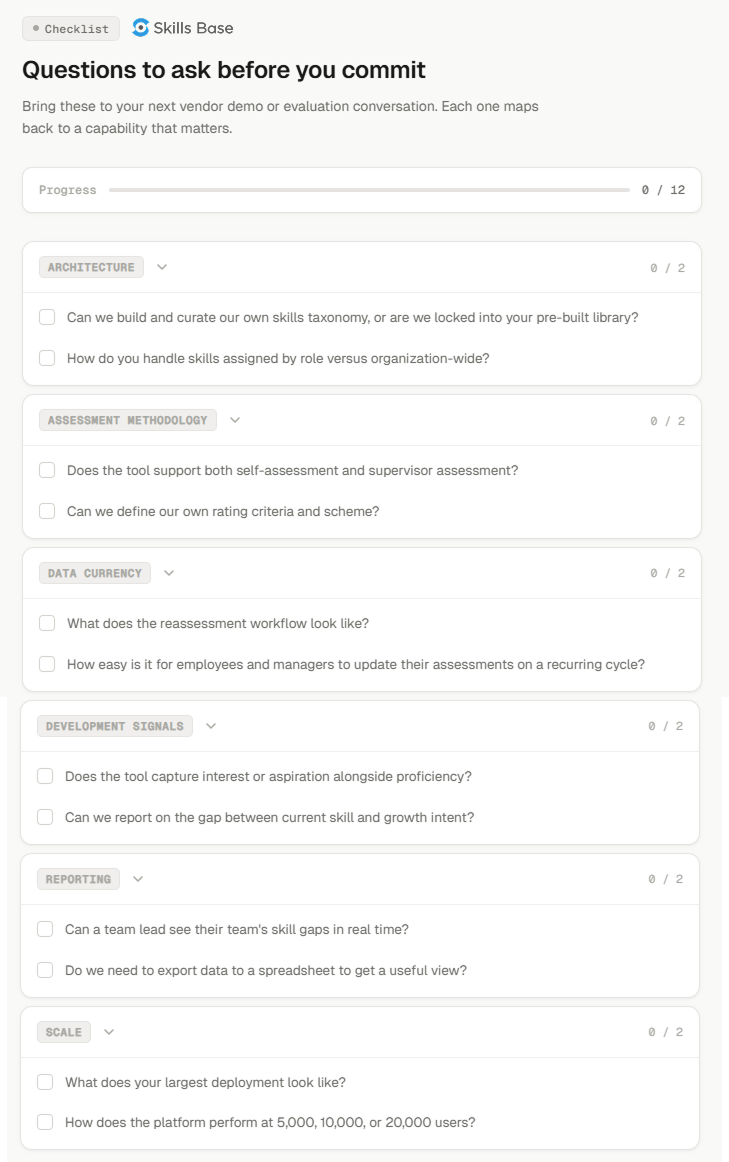
- On architecture: Can we build and curate our own skills taxonomy, or are we locked into your pre-built library? How do you handle skills assigned by role versus organization-wide?
- On assessment methodology: Does the tool support both self-assessment and supervisor assessment? Can we define our own rating criteria and scheme?
- On data currency: What does the reassessment workflow look like? How easy is it for employees and managers to update their assessments on a recurring cycle?
- On development signals: Does the tool capture interest or aspiration alongside proficiency? Can we report on the gap between current skill and growth intent?
- On reporting: Can a team lead see their team’s skill gaps in real time? Do we need to export data to a spreadsheet to get a useful view?
- On scale: What does your largest deployment look like? How does the platform perform at 5,000, 10,000, or 20,000 users? What does your onboarding and migration process look like for large teams?
The answers will tell you more than any feature comparison chart. A skills assessment tool built for real workforce decisions will answer every one of them without hesitation.

