



The modern organization sits on a goldmine of data but starves for insight. We spent the last decade collecting data points—employee profiles, learning histories, performance reviews, and skills taxonomies. We built “data lakes” that quickly became data swamps. HR leaders and executives now face a paradox: they have more information than ever, yet they still struggle to answer simple questions like “Do we have the skills to deliver our 2026 strategy?” or “Who is our biggest flight risk?”
Traditional business intelligence (BI) tools failed to solve this. They gave us dashboards. Dashboards are static. They require a human to interpret them, find the patterns, and decide what to do next. They are passive mirrors reflecting the past, not active partners shaping the future.
This is where AI Agents enter the frame. We are moving beyond “smart” dashboards and chatbots into the era of Agentic AI. These are not tools you simply use; they are digital team members you deploy to solve specific, high-value business problems.
This article defines AI agents within the context of talent intelligence, outlines their distinct advantages over traditional software, and explores the specific use cases that are reshaping how organizations manage their most critical asset: their people.
Defining AI Agents in Talent Intelligence
To understand AI agents, we must distinguish them from the “Generative AI” that dominated the headlines recently. A standard Large Language Model (LLM) like ChatGPT is a conversationalist. You ask it a question, and it predicts the next likely word. It is reactive.
An AI Agent is goal-oriented. It does not just wait for a prompt; it works to achieve a specific outcome. In the context of talent intelligence, an AI agent acts as a specialized analyst. It has a specific job description, access to your raw skills data, and a mandate to deliver actionable insights.
Think of the difference between a library and a research assistant.
- Traditional Software (The Library): You have to know what you are looking for, walk to the right shelf, pull the book, and read it to find the answer.
- AI Agent (The Research Assistant): You say, “Find me the risks in our engineering department,” and the agent scours the data, identifies the gaps, flags the expiring certifications, and presents a prioritized list of actions.
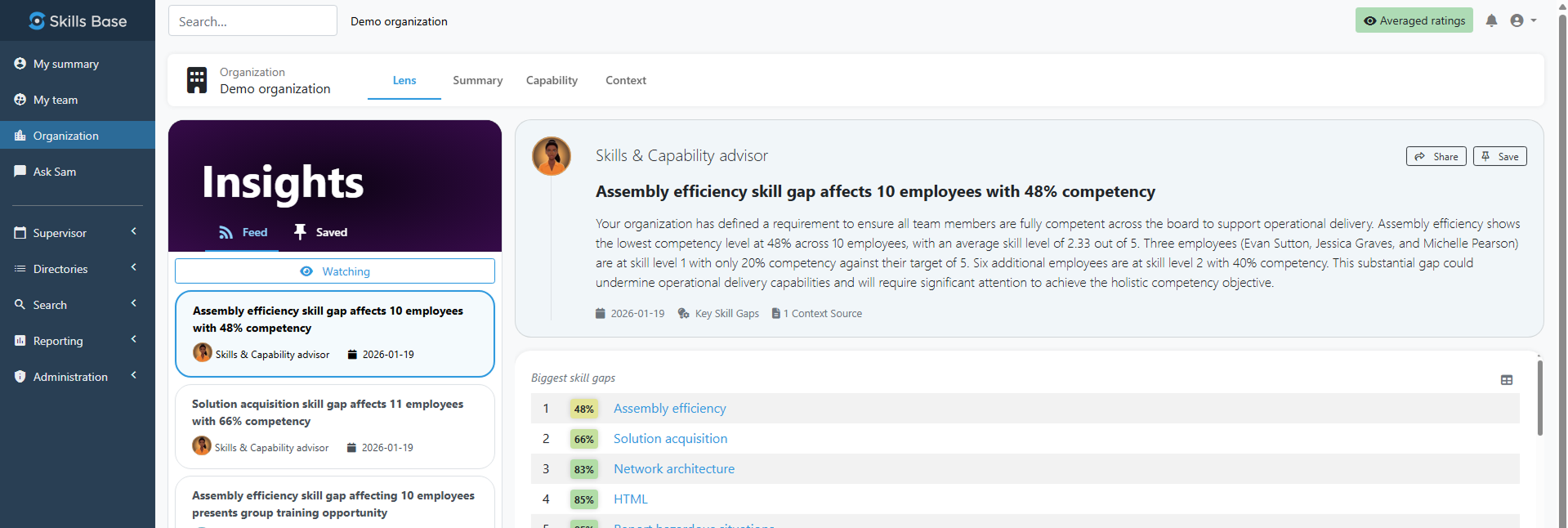
In Skills Base, we call this Skills Lens. It is not a passive reporting tool. It is a collection of specialized agents—like Sam the Data Analyst or the Risk Intelligence agent—that actively monitor your workforce data to find opportunities and threats you would otherwise miss.
The Advantages of an Agentic Approach
Why should an organization hand over analysis to AI agents? The answer lies in speed, scale, and objectivity. Humans are brilliant, but we are slow, and we are biased. We cannot scan 5,000 employee profiles in three seconds to find a “hidden expert.” Agents can.
- Moving from Reactive to Proactive – Traditional HR reporting is a post-mortem. We look at turnover rates after people leave. We look at skill gaps after a project fails. AI agents flip this dynamic. An agent focused on Workforce Planning or Risk Intelligence monitors trends in real-time. It sees the “skill decay” before it becomes a gap. It flags the “single point of failure” before that expert resigns. This allows leaders to intervene, not just clean up the mess.
- Democratization of Data – Data has historically belonged to the “gatekeepers”—the data analysts and HR admins who know how to run SQL queries or build complex pivot tables. This creates a bottleneck. If a frontline manager wants to know who has Java skills in their team, they have to file a ticket and wait two weeks. Agents like Sam (our Data Analyst agent) shatter this bottleneck. They allow anyone with permission to ask questions in plain English. “Show me all Java-certified engineers in Sydney.” The agent understands the intent, queries the raw data, and delivers the answer instantly. This empowers decision-making at the edge of the organization, rather than hoarding it in the center.
- Contextual Relevance – Data without context is noise. A dashboard showing “80% proficiency in Python” is meaningless unless we know why that matters. Is Python critical to our strategy? Is that number going up or down? Agents operate with Context & Goal Setting. They understand the business objectives. They do not just dump data on your desk; they prioritize insights based on what matters to your unique definition of success. If your goal is “Digital Transformation,” the agent highlights digital skills and ignores unrelated data.
Key Use Cases for AI Talent Agents
The true value of AI agents appears when we apply them to specific, expensive business problems. We can categorize these agents into three operational pillars: Strategic Planning, Risk & Governance, and Operational Efficiency.
Pillar 1: Strategic Planning and Alignment
The biggest disconnect in business today is between the C-Suite’s strategy and HR’s execution. Executives set a goal (e.g., “Become a leader in AI”), but HR lacks the visibility to confirm if the workforce can deliver it.
- The Context & Goal Setting Agent – This agent bridges that gap. It translates high-level corporate strategy into a clear, measurable plan within the platform. It guides leaders in articulating specific business goals. Once the system understands the goal, it filters out the noise. It automatically prioritizes insights that move the needle on that specific objective. It connects skills data directly to business outcomes.
- The Workforce Planning Agent – Once the goal is set, you need to know if you can reach it. This agent analyzes the current skill trajectory of the workforce. It answers the question, “If we do nothing, where will we be in 12 months?” It pinpoints where capabilities are organically growing and where deficiencies are forming. This allows organizations to stop reacting to talent needs and start proactively building the team they need for next year. You build your future workforce on data, not guesses.
Pillar 2: Risk, Governance, and Quality
Talent risks are business risks. If your only certified safety inspector retires, operations stop. If your engineering team’s skills become obsolete, product innovation dies.
- The Risk Intelligence Agent – This agent acts as a 24/7 watchdog. It identifies business-critical risks by analyzing skill trends. It flags declining capabilities. It spots compliance risks from expiring certifications. Crucially, it pinpoints high-value skills at risk of attrition. It helps organizations spot and fix “single points of failure” before they break the business. It allows HR to answer the terrifying question, “What is our biggest risk right now?” with confidence.
- The Skills Assessment Agent – Data is dangerous if it is wrong. We need to trust the data we use to make decisions. This agent ensures assessment integrity. It identifies rating inconsistencies between supervisors. It flags misalignments where an employee rates themselves a 5/5 but their manager rates them a 2/5. It spots when completed training requires a reassessment. This builds a rock-solid, trustworthy skills database. It validates that the data represents reality.
- The Skills Directory Agent – Skills frameworks tend to bloat over time. You end up with five different spellings of “Project Management” and hundreds of skills nobody uses. This agent optimizes the framework. It analyzes skills with low proficiency and interest and flags them for deprecation. It helps “prune the tree,” ensuring the framework stays focused on relevant, future-fit skills. It cuts administrative overhead and simplifies the user experience.
Pillar 3: Operational Efficiency and Growth
This is where we turn talent intelligence into ROI. How do we get the most out of the people we have?
- The Resource Optimization Agent – Organizations often hire expensive contractors because they do not know they already have the talent in-house. This agent unlocks hidden potential. It identifies highly skilled individuals who are not currently using those skills in their primary role. It provides an actionable list of “hidden experts.” This allows resource managers to staff key projects with internal experts immediately, boosting engagement and saving on external hiring costs.
- The Recruitment Agent – Recruiting is often an order-taking function. A manager asks for a role; a recruiter posts a job ad. The Recruitment Agent transforms this into a strategic process. It optimizes hiring by looking at internal skill gap data first. It identifies capability clusters to fill. It searches for internal candidates before looking externally. It ensures you hire for the exact skills you need, not just generic job titles. This reduces time-to-fill and improves the quality of new hires.
- The Learning & Development (L&D) Agent – L&D budgets are often the first to get cut because ROI is hard to prove. This agent changes the math. It delivers data-driven insights to maximize impact. It pinpoints high-interest development opportunities that align with business needs. It identifies which training actually improved skills and flags ineffective programs that consumed budget without delivering results. It helps leaders stop defending the L&D budget and start proving its value with hard evidence.
The Role of the Analyst: Meet Sam
Finally, we must address the user experience. Powerful tools are useless if they are too hard to use.
Sam, the Data Analyst Agent Sam represents the ultimate goal of AI: simplicity. Sam is an on-demand data analyst. It allows any authorized user to interrogate raw skills data using natural language. You do not need to know how to build a report. You just ask.
- “Who are our top Project Managers in London?”
- “Show me the skill gaps in the Sales team.”
- “Which department has the highest proficiency in Cloud Computing?”
Sam returns immediate, specific answers. This removes the “fear of data” that paralyzes many HR professionals. It turns every people leader into a data-driven decision-maker.

Conclusion
The era of managing talent via spreadsheets and gut instinct is over. It is too slow, too risky, and too expensive. But replacing spreadsheets with static dashboards is not the answer. The answer lies in agency.
AI agents for talent intelligence offer a fundamental shift in how we operate. They allow us to structure our data, contextualize it against our goals, and receive active, push-based insights that drive action. Whether it is Risk Intelligence protecting the bottom line, Resource Optimization unlocking hidden capacity, or Sam answering the daily questions, these agents empower organizations to make better talent decisions.
They challenge the status quo of “how we’ve always done it.” They cut through the noise. They help us build a digital model of our workforce capabilities that is dynamic, accurate, and undeniably valuable. This is not just about HR technology; it is about business agility. The organizations that deploy these agents will possess a clarity and speed of execution that their competitors cannot match.

