

Skills Gap Analysis Tool
Close the Gaps, before the work. Automate Action.
Get a precise, data-driven view of skill gaps, hidden strengths, and employee interests across your entire workforce — so every talent decision drives real impact in the flow of work.
Trusted by 400+ Global Organizations


What used to take us three days to assign engineers to projects now takes only 30 minutes.

Jay Canfield,
Director of Professional Services
Skills reporting & visualization for every level of your org.
From individual training plans to global readiness heatmaps, get the insights you need to lead and drive automation. Slice, dice, and analyze every metric.
For Resource Allocation
Find the right person in seconds.
Search your entire workforce by skill, proficiency level, location, and availability. Stop relying on word of mouth — surface verified talent instantly with precision matching.
Integrate allocation into workflow via API or MCP Server.
Team
Role
Location
Custom Fields
Interest Levels
Skill Levels
Proficiency Levels

For Skill Visibility
Spot every gap at a glance.
Visualize capability density across entire teams or departments in a single heatmap view. See who excels, who needs support, and where critical gaps are forming.
Power the flow of work with ERP plug-ins and MCP-driven agents.
Individual
Team
Role
Location
Org
For Granular Reporting
A 360° view of every entity.
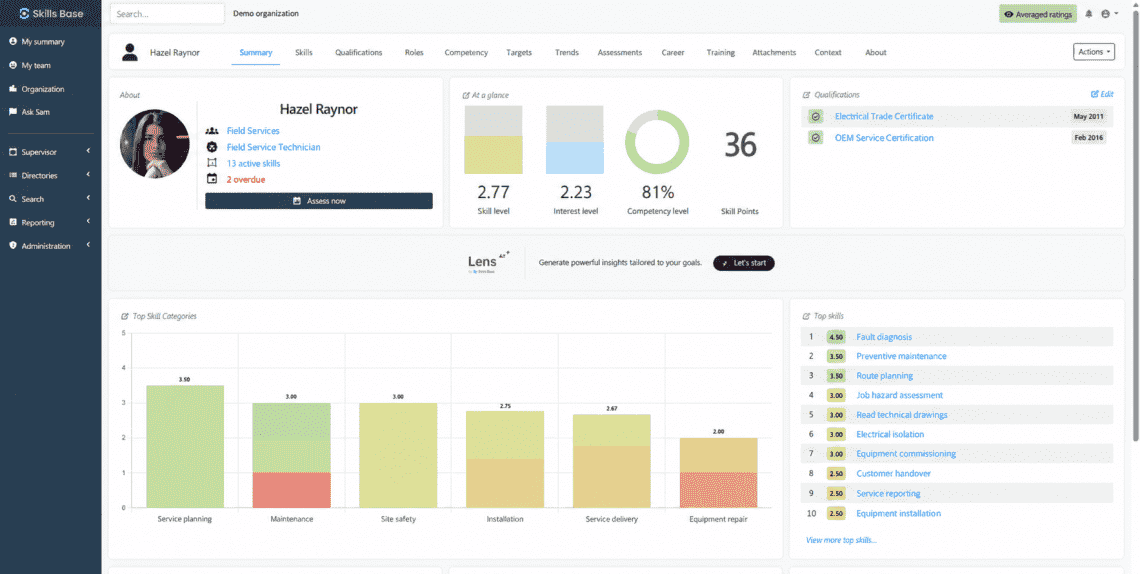
A dedicated dashboard for every team, role, location, and individual in your organization. Drill into proficiency strengths, gap counts, and trend lines — all in one place, automatically powering your workforce decisions.
Individual
Team
Role
Location
Org
Skill
Skill Category
For Strategic Insight
Competency Analysis
Aggregate analysis for high-level planning. Visualize concentrations of skill across locations and business units to inform resource allocation.
Team
Role
Location
Org
For Training Optimization
Skill Trends
Track the velocity of skill acquisition over time. Are you building capability in Generative AI, or is it atrophying due to churn?
Individual
For Performance Benchmarking
Proficiency vs. Target
Spot actual skill gaps against required targets. See exactly where your team falls short of role expectations — no guesswork required.
Team
Role
Location
Org
Individual
For Talent Retention
Internal Career Mobility
Visualize internal pathways. Calculate percentage fit against alternative roles to identify candidates for lateral moves, promotion, or succession planning. Keep top talent engaged with a clear future inside your organization.
Individual
For Workforce Planning
Capability Targets
Set required headcount targets at specific proficiency levels. Track “Do we have enough?” in real-time for any team, role, or location.
Team
Role
Location
Training Impact
Validate L&D ROI. Correlate courses completed with actual proficiency improvements over time to see what’s working.
Individual
For Data Exports
Report Builder
Build and export custom reports across any dimension. Schedule automated delivery so stakeholders always have fresh workforce intelligence.
Team
Role
Location
Org
Individual
AI Skills Intelligence
Intelligence at the Moment It Matters.
Reports tell you what happened. AI tells you what to do next. Two purpose-built models that turn your verified skills data into decisions — instantly.
- Sam AI
Natural Language
Skills Interface
Interact with verified data insights using the power of conversation. Ask anything about your workforce — Sam surfaces the answer instantly from your live skills data.

- Skills Base Insights
Automated Strategic
Workforce Intelligence
Connect capability data to your organization’s long-term goals. Insights model where your workforce is heading — surfacing strategic risks and investment opportunities months before they become visible.
Skills Management
Everything you need to manage skills at scale.
SkillsBase is a complete skills management system — not just a reporting tool. Every capability your organisation needs, connected in one place.
01
Track
Skill and certification tracking in one place. Maintain a single source of truth for your workforce data — always current, always verified, always trusted.
Skills Tracking ->
02
Model
Build a skills taxonomy that’s uniquely yours. Define the language, structure, and proficiency levels that reflect how your organisation actually thinks about capability.
Skills Taxonomy ->
03
Map
Align your skills data to your business architecture and design. Understand how capability maps to your organisational structure, functions, and strategic priorities.
Skills Mapping ->
05
Measure
Uncover gaps, strengths, and interest levels across your workforce. Go beyond headcount and job titles to see what your people can actually do — and what they want to develop.
Skills Assessment ->
05
Compare
Skills matrices that update in real time. View skills data side by side across teams, roles, and individuals — dynamically filtered to surface exactly what you need to see.
Skills Matrices ->
06 – You are here
Analyze
Deep insight and rich visualizations to support every talent decision. From team-level reporting to org-wide trends, turn your skills data into intelligence that drives action.
Skills Analysis ->
Skills Gap Analysis: Your Questions Answered
Everything you need to know about identifying, measuring, and closing skill gaps across your workforce.
What is a skills gap analysis?
A skills gap analysis is a structured process for comparing the skills your workforce currently has against the skills your organization needs, both now and in the future. It identifies where gaps exist, how severe they are, and which areas to prioritize for development, hiring, or redeployment.
Unlike informal talent reviews, a proper skills gap analysis is data-driven. It draws on proficiency assessments, role requirements, and business strategy to produce actionable insight, not just a spreadsheet of names and ratings.
How do you conduct a skills gap analysis?
A thorough skills gap analysis typically follows six steps. First, define the skills that matter by building or adopting a skills taxonomy tailored to your organization’s roles and strategic direction. Second, assess current proficiency using self-assessments, and manager validations to capture where people actually stand. Third, set target proficiency levels for each role so you have a clear benchmark. Fourth, compare actuals against targets to surface the gaps. Fifth, prioritize by severity, strategic importance, and urgency. Sixth, take action, whether that’s targeted training, internal mobility, or external hiring.
Skills Base automates steps two through five, giving you real-time gap visibility through visual dashboards and heatmaps instead of static spreadsheets.
Do I need a skills gap analysis template or an actual tool?
It depends on your scale. A skills gap analysis template in Excel or Word can work for a small team: typically you’d list employees, their skills, current proficiency, target proficiency, and the gap score. You can find free templates in our Skills Data Library to get started.
However, spreadsheet templates break down quickly. They go stale the moment someone changes role, they can’t aggregate across teams or locations, and they offer no visualization. If you’re running a skills gap analysis across more than one team, or you want it to be an ongoing capability rather than a one-off project, dedicated skills gap analysis software will save significant time and deliver far richer insight. Skills Base gives you live heatmaps, filterable matrices, and automated gap scoring out of the box.
What should I look for in a skills gap analysis tool?
The best skills gap analysis tools go well beyond a simple comparison grid. Look for a platform that combines skills assessment, taxonomy management, and visual reporting in one place. Key capabilities include customizable proficiency scales, role-based target setting, real-time skills matrices and heatmaps, filtering by team, location, and role, and the ability to track skill trends over time.
It’s also important that the tool supports interest-level data. Knowing which skills employees want to develop gives you a powerful lever for engagement and internal mobility that pure gap scores miss. Skills Base captures proficiency, interest, and target data in a single assessment flow, then surfaces gap analysis across every level of your organization.
Can AI automate skills gap analysis?
Yes, and it’s quickly becoming the standard for organizations managing skills at scale. AI-powered skills gap analysis can surface patterns, predict emerging shortfalls, and recommend actions far faster than manual review.
Skills Base offers two purpose-built AI models for this. Sam is a natural-language interface that lets you query your live skills data conversationally. Ask things like “which teams have the biggest gap in cloud architecture?” and get an instant, sourced answer. Lens goes further, connecting your skills data to strategic goals to model where your workforce is heading and flag risks before they materialize. Both are grounded in your verified, assessed skills data, not inferred from job titles or resumes.
How do you run a skills gap analysis for employees across an entire workforce?
Scaling a skills gap analysis from one team to an entire workforce requires a platform that can handle organizational complexity: multiple teams, roles, locations, and reporting lines. The process starts with a shared skills taxonomy so everyone is assessed against the same language, followed by structured assessments rolled out at scale.
In Skills Base, every employee, team, role, and location gets its own dedicated dashboard. You can drill from an org-wide heatmap all the way down to an individual’s proficiency vs. target comparison, and slice the data by any dimension. This makes it possible to run a workforce-wide skills gap analysis continuously, not just as a once-a-year project.
What are the benefits of conducting a skills gap analysis?
A well-executed skills gap analysis delivers impact across multiple areas. It lets you target L&D spend on the gaps that actually matter, rather than guessing or spreading budget evenly. It improves resource allocation by matching people to projects based on verified capability. It strengthens workforce planning by revealing whether you’re building or losing critical skills over time. And it supports talent retention by surfacing internal career mobility paths that keep top performers engaged.
Perhaps most importantly, it replaces assumptions with evidence. When you know exactly where your gaps are, every talent decision becomes sharper and more defensible, from hiring priorities to succession planning.
What are the common challenges with skills gap analysis?
The most common challenge is data staleness. Organizations invest effort in a one-off analysis only to have the results go stale within months as people move, leave, or develop new skills. The second is inconsistent language: without a shared taxonomy, different teams describe the same skill differently, making aggregation unreliable. Third, many approaches stop at identifying gaps without connecting them to actionable next steps like targeted training or internal mobility.
Skills Base is designed to address all three. Continuous assessment keeps data current, a centralized taxonomy ensures consistency, and built-in reporting connects gap data directly to development planning, resource allocation, and career pathing.
What does a skills gap analysis look like in practice?
As a practical example: an engineering team defines 30 key skills across software development, cloud infrastructure, and security. Each team member self-assesses their proficiency on a five-point scale, and their manager validates. The platform compares each person’s actual proficiency against the target required for their role, then visualizes the result as a skills matrix heatmap.
Immediately, the team lead can see that cloud security skills are running 1.5 points below target across the board, while Python proficiency is actually exceeding expectations. That insight drives a focused training investment in cloud security and potentially identifies a Python mentor within the team. In Skills Base, this kind of analysis is available at every level, from individual employees up to the whole organization.
Can I use a skills gap analysis for individual or personal development?
Absolutely. A personal skills gap analysis compares an individual’s current proficiency against the requirements for their current role, or a role they aspire to. This makes it a powerful tool for career development planning and performance conversations.
In Skills Base, every individual has their own dashboard showing proficiency vs. target for each assigned skill, along with an internal career mobility view that calculates percentage fit against alternative roles in the organization. Employees can also indicate their interest level in developing specific skills, giving managers a clear signal for where coaching and development opportunities will have the most engagement.
Ready to uncover hidden opportunities?
Join 400+ organizations using using Skills Base to manage verified skills data
- Free for 25 Users
- Free trial available
- No Credit Card required