

Skills Assessment Software
Clarity into workforce capability, finally.
Identify skill gaps, validate strengths and capture development interests with skills assessment software that supports targeted training and confident workforce assignments.
Trusted by 400+ Global Organizations


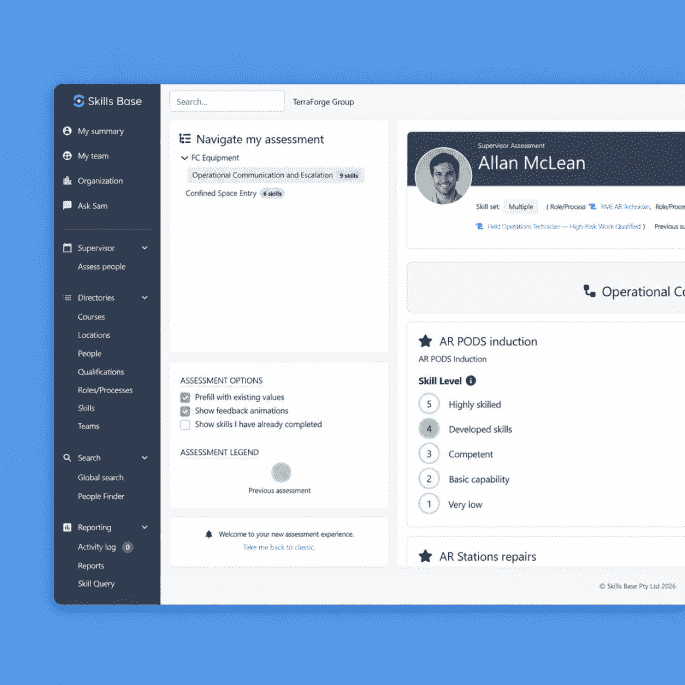
Verified Skills Data, you can actually trust.
Move beyond guesswork with a platform powered by over 100 million validated data points. Turn employee and supervisor assessments into an objective baseline for your most critical workforce decisions.
Remove Bias
Eliminate self-reporting errors. Supervisor workflows validate ratings against clear definitions.
Build a Common Language
Create a shared vocabulary. Standardized scales ensure consistency across teams and departments.
Fix Data Decay
Stop data rot. Automated nudges and Insights ensure your skills inventory never goes out of date.
See the whole picture
Go beyond ability. Map competence against employee interest to visualize true workforce potential.
Stop guessing with spreadsheets
Manual surveys lead to low completion rates and biased data.
Spreadsheets
- Low completion rates (email nagging)
- Subjective "gut feel" ratings
- No historical progression data
Skills Base
- Automated workflow for assessments, notifications & nudges
- Supervisor validation workflow
- Clear definitions for 1 to "x" scales
“Skills Base has transformed the way we manage and develop our technicians’ skills. The visibility and consistency it provides are invaluable. Our technicians now have a clear path for growth, and we can deploy them more effectively, improving our overall service quality.”

Mike Soucy,
Digital Transformation Leader
Talent Development Designed for Real Work
One size doesn’t fit all. Choose the right assessment type for the right moment to maximize engagement and data quality.
For a Baseline Review
Employee Self Assessment
High-quality talent data starts at the source. By enabling employees to self-report their capabilities, you build a dynamic, real-time inventory of your organization’s collective strength, gap an interest.
For a Validation Review
Supervisor Assessment
Leaders validate and calibrate ratings to ensure data accuracy and objective proficiency across the board.
For project or course completion
Ad hoc Review
Designed for micro-cycles, this allows users to level up their skills immediately after a big win, a training session, or a coaching breakthrough.
For a Quarterly Review
Quick Review
Complete a comprehensive assessment on a single screen, perfectly synced to your team’s evaluation rhythm.
For a creating a proficiency baseline
Target Assessment
Define the “To-Be” proficiency for any role to automatically identify and bridge critical skill gaps.
Assessment Intervals
Configure cadence: Quarterly, Bi-Annually, or Annually. Keep data fresh without fatigue.
Assessment Comments
Add qualitative context to ratings. Explain “Why” a skill level was chosen.
Trigger Reminders
Automated email nudges for incomplete and upcoming assessments.
AI for Assessments
Assessment intelligence that works for you.
Running assessments is only half the work. Skills Base’s AI helps you design better assessments, reduce bias in scoring, and surface the insights that matter once results are in — so every cycle delivers more than a spreadsheet of scores.
- Skills Base Insights
Assessment Cycle Intelligence
Monitor your assessment cycles for completion risk, scoring anomalies, and result patterns — flagging issues before they distort your skills data and surfacing the capability gaps that need action.

Skills Management
Everything you need to manage skills at scale.
SkillsBase is a complete skills management system — not just a reporting tool. Every capability your organisation needs, connected in one place.
01
Track
Skill and certification tracking in one place. Maintain a single source of truth for your workforce data — always current, always verified, always trusted.
Skills Tracking ->
02
Model
Build a skills taxonomy that’s uniquely yours. Define the language, structure, and proficiency levels that reflect how your organisation actually thinks about capability.
Skills Taxonomy ->
03
Map
Align your skills data to your business architecture and design. Understand how capability maps to your organisational structure, functions, and strategic priorities.
Skills Mapping ->
04 – You are here
Measure
Uncover gaps, strengths, and interest levels across your workforce. Go beyond headcount and job titles to see what your people can actually do — and what they want to develop.
Skills Assessment ->
05
Compare
Skills matrices that update in real time. View skills data side by side across teams, roles, and individuals — dynamically filtered to surface exactly what you need to see.
Skills Matrices ->
06
Analyze
Deep insight and rich visualizations to support every talent decision. From team-level reporting to org-wide trends, turn your skills data into intelligence that drives action.
Skills Analysis ->
The Skills Assessment FAQ: Validating Workforce Capability
Everything you need to know about effectively measuring, assessing and validating skills.
What is a skills assessment?
A skills assessment is a systematic process used to evaluate the proficiency of your workforce against the specific requirements of their roles. Unlike a standard test, a modern assessment reviews both technical know-how and behavioral competency. It provides objective data on your team’s actual capabilities, allowing you to move beyond assumptions and make evidence-based decisions about hiring, training, and promotion.
How is a skills assessment different from a performance review?
A performance review typically looks backward at what an employee achieved over the last year (KPIs and goals). A skills assessment looks forward at the talent’s potential and current capability. It focuses on how they do the work, not just the outcome. By separating competency evaluation from performance reviews, you encourage employees to be honest about their gaps without fear of it affecting their bonus or salary.
Why shouldn't we use spreadsheets for skills assessments?
Spreadsheets are static and prone to bias. In a manual spreadsheet, data is often self-reported and rarely verified, leading to “capability inflation.” Furthermore, a spreadsheet cannot secure sensitive talent data or provide an audit trail of who changed a rating and when. Dedicated platforms ensure that every competency rating is verified, secure, and dynamically updated as employees complete new certifications or projects.
How do we ensure assessment ratings are objective and accurate?
The “Self-Assessment vs. Manager Assessment” model is the gold standard. First, the employee rates their own proficiency. Then, a manager or subject matter expert validates that rating. This “calibration” process sparks necessary conversations about performance and ensures the workforce data reflects reality. Advanced assessments may also use peer reviews or practical tests to further triangulate the true level of competency.
Does running skills assessments negatively impact employee morale?
It actually improves morale, if framed correctly. High-performing talent often leaves because they feel their growth has stalled. A structured assessment signals that the organization is invested in their professional development. By using the data to build personalized learning paths rather than just for “testing,” you demonstrate a commitment to their future, which is a powerful retention tool for your core workforce.
How does this data support strategic workforce planning?
You cannot plan for the future if you don’t know what you have today. Aggregated assessment data generates a “Skills Gap Analysis,” highlighting the difference between the competencies you possess and the ones you need for upcoming projects. This allows HR and leadership to budget accurately for training, hiring, or redistributing talent to meet strategic goals before a crisis hits.
Ready to measure what matters?
Join 400+ organizations using using Skills Base to manage verified skills data
- Free for 25 Users
- Free trial available
- No Credit Card required