


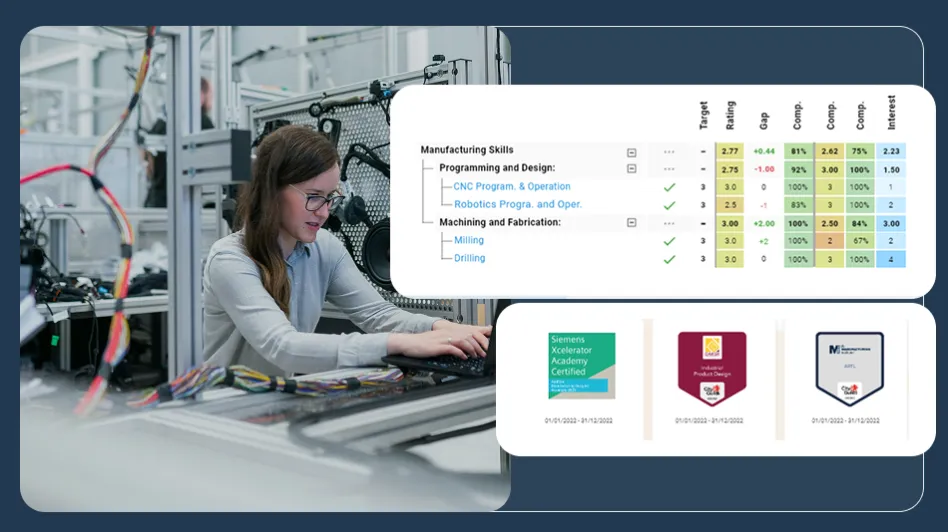
Manufacturing does not have a shortage of problems. It has a visibility problem. The manufacturing skills gap is real: the industry needs 3.8 million new workers by 2033, according to Deloitte and The Manufacturing Institute, and nearly half of those roles could go unfilled. But the deeper issue is not just finding people. It is knowing what your existing workforce can actually do, what certifications they hold, and where the critical gaps sit right now. Most organizations still track this information in spreadsheets, filing cabinets, and the heads of supervisors. That is not a skills strategy. It is a blind spot.
The manufacturing skills gap is a visibility problem
The manufacturing skills gap is often framed as a hiring crisis. Not enough welders. Not enough CNC machinists. Not enough engineers. The skilled labor shortage in manufacturing dominates headlines, and for good reason. 65% of manufacturers now cite attracting and retaining talent as their primary business challenge, according to the National Association of Manufacturers. But the bigger issue is what happens inside the organizations that already have people on the floor.
Most manufacturing leaders cannot answer basic capability questions in real time. Which operators are certified for which machines? Where are the single points of failure across shifts? Which certifications expire next month? When that information lives in disconnected systems, the skills gap in manufacturing is not just a workforce planning problem. It is an operational blind spot that grows quietly until something breaks.
A skills-based approach to manufacturing reframes the challenge. The first step is not hiring. It is building a clear, structured picture of what your workforce can do today.
What invisible capability gaps actually cost you
The cost of a skills gap is not abstract. It shows up in specific, measurable ways. A forklift operator whose license expired last month gets assigned to a shift because nobody checked. A machine guarding violation goes uncaught because the training record lives in a spreadsheet that has not been updated since the last audit. A critical safety certification lapses and the organization only discovers it when OSHA does.
These are not hypothetical scenarios. OSHA’s maximum penalty for a single willful violation now exceeds $165,000, and machine guarding and lockout/tagout violations consistently rank among the most-cited standards in manufacturing. The financial risk is real. But so is the human risk: unqualified people in safety-critical roles because nobody had a clear view of their credentials.
Beyond compliance, invisible gaps erode operational performance. Production schedules built without verified skill data lead to misallocation: the wrong person on the wrong task, at the wrong time. Organizations that cannot see their capability gaps end up throwing training budgets at problems reactively, after the failure, instead of targeting investment where it will prevent the next one.
Centralized skill and certification tracking replaces the guesswork. A proper manufacturing skills certification system gives you automated expiry alerts, a single verified record per person, and audit-ready reporting without the scramble.
Why spreadsheets cannot keep up with a changing workforce
Spreadsheets were never designed to model workforce capability. They are flat, static, and siloed. A supervisor maintains a matrix for their shift. Another supervisor maintains a different one for theirs. Neither version talks to the other, and both are outdated the moment someone completes a new certification or transfers to a different line.
The pace of change makes this worse. The World Economic Forum estimates that 40% of core manufacturing skills will change in the next five years. Automation, robotics, AI-enabled processes, and new safety protocols are reshaping what competency looks like on the floor. A static grid in Excel cannot track proficiency levels, model certification dependencies, or surface patterns across sites and shifts. It gives you a snapshot. What you need is a live feed.
And the scale of the reskilling challenge is not slowing down. The same WEF Future of Jobs Report 2025 found that 63% of employers identify skill gaps as the single biggest barrier to business transformation. Transformation requires measurement, and you cannot measure workforce capability in a spreadsheet that nobody trusts.

A single source of truth for manufacturing skills
Manufacturing skills management software replaces the patchwork. Instead of scattered files and tribal knowledge, you build a structured, centralized data model of your organization’s capabilities.
You create a skills taxonomy that reflects how your organisation actually talks about capability: the specific technical skills, safety certifications, and operational competencies that matter for your roles and your industry. You map those skills to roles, teams, shifts, and locations so the data has operational context. You run a structured manufacturing skills assessment so proficiency is measured, not assumed. And you track certifications with automated expiry alerts so compliance gaps surface before they become incidents.
This is what manufacturing skills tracking software looks like when it is done right: not a static file, but a living system. The result is a real-time manufacturing skills matrix that every stakeholder can access. HR sees where to target development spend, plant managers see shift coverage and certification status, and leadership sees the capability posture of the entire operation. A skills gap analysis stops being a quarterly project and becomes a continuous, live view of where you stand versus where you need to be.
This is not about replacing judgment with software. It is about giving the people who make talent decisions the verified data they need to make good ones.
Skills intelligence turns visibility into action
Structured skills data is the foundation. Skills intelligence in manufacturing is what makes it strategic.
Skills Lens, an AI-powered skills intelligence platform, takes verified workforce data and turns it into prioritized, goal-aligned insight. Instead of staring at a matrix and trying to interpret patterns manually, Skills Lens does the analysis for you. It flags compliance risks from expiring certifications. It identifies single points of failure. If only two people in your facility hold a critical safety qualification and both are nearing retirement, that is a business continuity risk you need to act on now, not discover later.
Skills Lens also aligns skills data to strategic goals. You set objectives at the organization, team, or role level, and the system surfaces the gaps, risks, and opportunities that matter most relative to those goals. For L&D leaders, this means training spend goes where the verified gaps are, not where someone guessed they might be. For executives, it means workforce risk becomes visible and quantifiable.
The retention case matters too. Deloitte research found that employees are 2.7 times less likely to leave within 12 months if they feel they can acquire skills that are important for the future. When your workforce can see their own gaps, their development paths, and where their interests align with organizational need, you build engagement alongside capability.
Stop guessing, start seeing your workforce clearly
The manufacturing skills gap will not close by hiring alone. Effective manufacturing skills gap solutions start with visibility: knowing what your workforce can do, where the gaps sit, and which risks need attention first. That means replacing fragile, disconnected systems with structured skills data. It means tracking certifications as rigorously as you track inventory. And it means using intelligence to turn that data into decisions that prevent failures instead of reacting to them.
If your team is still piecing together capability data from spreadsheets, email threads, and shift supervisors’ memories, Skills Base for manufacturing is a practical place to start. You get the visibility to manage today and the insight to plan for tomorrow.
The workforce you need is partly the one you already have. You just need to see it clearly.

