


In a hospital ward, a high-voltage substation, or a CNC production cell, “qualified” is not a box on a form. It is the difference between safe, compliant work and an incident that ends up in a regulator’s report. Yet in most organizations, the record of who is actually qualified to do what still lives in a spreadsheet that one person updates and everyone else quietly distrusts. If that tension feels familiar, you are already past the question of whether it is a problem. The real question is whether competency management software is the fix, and what it would actually change.
Hard competencies are different, and harder to manage
Not all competencies behave the same way. A soft skill like communication is real and valuable, but you will rarely fail an audit over it. A hard competency is another matter: a welding certification, an electrical isolation authorization, a sterile-processing procedure, an equipment calibration sign-off. These are technical, verifiable, and usually time-bound. The gap between “we think Sam can do this” and “we can prove Sam is currently certified to do this” is exactly where risk lives. Being precise about the difference between skills and competencies is not pedantry, because it shapes how you track them.
Three things make hard competencies harder to manage than soft skills. They expire, so a record that was accurate last quarter may be wrong today. They are regulated, so someone external can ask you to prove them at any time. And they are consequential, because an unqualified person on a critical task is a safety event waiting to happen. Track them casually and you are not saving time. You are deferring risk.
Why competency management software is moving from nice-to-have to necessary
For years, manual tracking survived because the workforce was relatively stable. That stability is gone. The World Economic Forum’s Future of Jobs Report 2025 found that around 40% of the core skills in manufacturing and supply chains will change within three to five years, and more than half of incumbent workers will need additional training by 2030. The competencies you are tracking are a moving target, not a fixed list.
At the same time, the people who hold those competencies are scarce. Research from Deloitte and the Manufacturing Institute, reported by ASME, projects a gap of as many as 3.8 million manufacturing jobs through 2033, with 1.9 million potentially going unfilled, while the National Association of Manufacturers reports that 77% of manufacturers already struggle to attract and keep workers. When qualified people are this hard to find, knowing precisely who is certified for what stops being an administrative chore and becomes operational risk management.
This pressure is sharpest where the work actually happens. Frontline workers need skills management software that reflects shift patterns, field conditions, and revalidation cycles, not an office tool retrofitted onto the shop floor. That is the gap competency management software is built to close.
The hidden cost of tracking competencies in spreadsheets
Spreadsheets feel free. They are not. The hidden cost shows up in three places, and none of them land on an invoice.
First, errors. Research associated with Dartmouth College, widely cited in compliance circles, found that 94% of operational spreadsheets contain errors, with nearly 2% of formula cells producing incorrect results. In a competency tracker, a wrong cell is not a typo. It is someone marked qualified who is not.
Second, silent failure. A spreadsheet stores an expiration date, but it will never tell you that date is approaching. It sits quietly until someone opens the file, which under operational pressure often happens after the certification has already lapsed.
Third, wasted effort. Gartner’s 2020 research estimates that poor data quality costs organizations an average of $12.9 million a year, much of it driven by manual handling, and McKinsey found that the average interaction worker spends 28% of the workweek on email and nearly another fifth hunting down internal information. Your compliance lead is not paid to be a human reminder system.
A purpose-built approach to skills and certification tracking replaces all three failure modes with one centralized, always-current record. That is only the baseline. The more interesting question is what a system does on top of it.
What competency management software actually does differently
The difference between a spreadsheet and competency management software is not polish, it is structure. A spreadsheet is a flat grid you maintain by hand. A system models how your competencies actually relate to people, roles, certifications, and training, then keeps that model live. Three capabilities matter most.
Model and structure competencies in one place
Before you can track anything well, you need a shared definition of what you are tracking. A good system lets you build a structured competency framework that mirrors your real roles, certification types, and revalidation cycles, rather than column headings someone invented on a Tuesday. This is also where training and competency management software earns its keep. Link each competency to the training that builds it, and development planning stops being guesswork.
See who is qualified at a glance
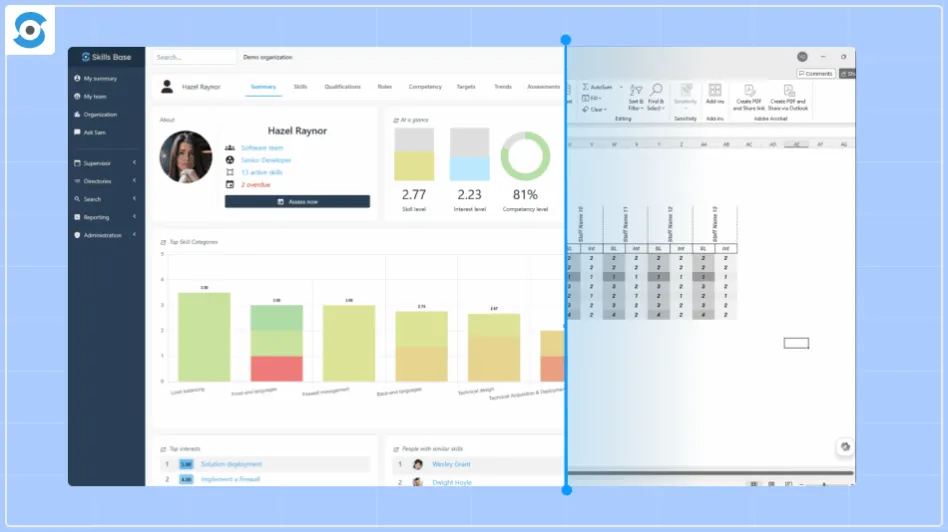
This is where competency management system software pays off day to day. Instead of scanning rows, you get real-time competency matrices that map people to roles and show coverage, strengths, and single points of failure instantly. Competency matrix software turns “who can cover this shift” from a frantic group chat into a two-second look.
Find the gaps before they find you
The best systems are proactive. Automated skills gap analysis flags expiring certifications and missing competencies before they become a problem, so you learn that an authorization lapses next month instead of discovering it during an incident review. The gap finds you either way. Software just makes sure it finds you first.
How to tell audit-ready software from a digital checkbox
Not every tool that calls itself competency management software will hold up when it matters. A few things separate the real thing from a digital filing cabinet.
Look for a defensible evidence trail. When an auditor asks who approved a competency, when, and on what basis, the system should answer in seconds with timestamped records, not send your team digging through email threads. Look for verification, not attendance. A record that someone sat through training is not proof they can perform the task, and regulators increasingly know the difference. The U.S. Department of Justice’s Operation Nightingale, which secured 30 convictions for fraudulent nursing credentials in 2023 and charged 12 more people in 2025, is a blunt reminder that a credential on file is not the same as a verified one.
Look for real-time data, because a competency record is only useful if it reflects today, not last audit cycle. And look for usability on the frontline, because a system only office staff can navigate will not get updated where the work happens. The strongest platforms go further, layering competency intelligence software on top of tracking so you can move from “who is qualified” to “where are we exposed, and what should we do about it.”
From compliance burden to competitive edge
Frame competency management as a compliance chore and you will treat it like one: a cost to minimize. The organizations getting real value flip that logic. Once your competency data is structured and trusted, audit-readiness becomes a byproduct rather than a quarterly fire drill, and the same data starts driving workforce planning, faster resourcing, and smarter training spend.
The payoff is measurable. Deloitte’s research on skills-based organizations found that fewer than one in five companies have adopted these approaches to a significant degree, but those that have report better business results than peers still anchored to job titles, while 60% of businesses say skills gaps are actively holding back transformation. Trusted competency data is what makes becoming a skills-based organization possible.
If your team is still maintaining a spreadsheet that one person understands and everyone hopes is current, the question is no longer whether that is a risk. It is how long you want to keep carrying it. Seeing what structured, real-time competency data looks like is the fastest way to decide whether the upgrade is worth it, and in a precision industry, the math usually makes itself.
FAQ
What is competency management software?
Competency management software is a platform that helps organizations define the skills and behaviors required for each role, assess how people measure against them, and close the gaps over time. It centralizes competency frameworks, self- and manager assessments, skills data, and development planning in one place, replacing the spreadsheets most teams start with. The goal is a live, organization-wide picture of capability rather than a once-a-year snapshot.
What's the difference between competency management and performance management?
Performance management is about how well someone is doing their job: goals, reviews, and outcomes over a period. Competency management is about what someone is capable of, meaning the specific skills and proficiency levels they hold against a defined framework. They’re complementary: competency data tells you whether someone is equipped to perform, while performance data tells you whether they did. Many organizations feed competency insights into performance and development conversations rather than treating them as the same process.
What are the key features to look for in a competency system?
The core capabilities most buyers evaluate are: a flexible competency framework builder, role-to-competency mapping, self and manager assessments, skills gap analysis, reporting and dashboards, and development or learning planning. Beyond the basics, look at how easily you can import or build frameworks, how proficiency levels are defined, and whether the tool surfaces gaps at individual, team, and organization level. Integrations with your LMS and HRIS are usually what determine whether the data stays current.
How does competency management software help with skills gap analysis?
It compares the competencies a role requires against the proficiency levels your people actually hold, then highlights the difference. Good tools let you see gaps at multiple levels (a single person, a team, a department, or the whole workforce) and filter by competency, role, or location. This turns a vague sense that “we’re short on certain skills” into a specific, prioritized list you can act on with targeted training, hiring, or redeployment.
Which industries use competency management software?
It’s used across regulated and skills-intensive sectors in particular, including healthcare, manufacturing, utilities, government, mining, and finance, where proving capability and compliance matters. Healthcare and aged care use it to evidence clinical competencies and credentials; manufacturing and utilities use it for safety-critical and technical skills; government uses it for workforce capability planning. Any organization that needs to know who can do what, and prove it, is a candidate.
How does competency management software support compliance?
It gives you a defensible, auditable record of who holds which competencies and when they were assessed or verified, which is essential in regulated industries. You can track credentials and expiries, flag when reassessment is due, and produce evidence for audits without assembling it manually. Instead of scrambling to prove compliance after the fact, you have a continuously maintained source of truth.

