


Most organizations have some record of their employees’ skills. A spreadsheet here, a field in the HRIS there, a performance review that touched on competencies last year. What they rarely have is skills data they can trust, at the depth and currency needed to make real workforce decisions. Skills data is a distinct, high-value data layer. Most HR platforms were never designed to maintain it at scale. According to the World Economic Forum’s Future of Jobs Report 2025, skills gaps are now the single biggest barrier to business transformation, cited by 63% of employers ahead of capital constraints, regulation, and culture. The problem is not that organizations ignore skills. It is that the tools they rely on were never built to manage them properly.
TLDR:
- Skills data is a distinct, high-value data layer that most HR platforms were never designed to maintain at the depth or scale organizations need
- Effective skills management software covers taxonomy building, tracking, assessment, measurement, and reporting — all working together to produce verified data you can trust
- AI turns verified skills data into intelligence you can act on, but must be applied carefully, particularly in measurement, where legislation like the EU AI Act draws clear boundaries
- Skills intelligence becomes most powerful when it flows into the systems your teams already use: HR platforms, LMS, BI tools, and workforce management
- A platform built only for skills can go further than one that treats skills as a feature — focus is not a constraint, it is what makes the data trustworthy
Why most organizations are flying blind on workforce capability
The HRIS is essential. It holds the record of who works in your organization, what their role is, and where they sit in the structure. But it was designed for that purpose, not for maintaining a living, structured model of what your people can actually do. Skills fields in an HRIS are typically free-text, self-reported, and rarely updated. They reflect what someone typed during onboarding, not what the workforce looks like today.
The result is that most organizations make talent decisions on instinct, tribal knowledge, or data that is months out of date. Research from Deloitte reinforces this: 83% of companies worldwide have low people analytics maturity, relying on static, inconsistent data rather than structured, verified insight. If your organization is still tracking skills in spreadsheets, you are not alone, but you are working with a tool that cannot scale, cannot verify, and cannot keep pace with how quickly skill requirements change.
The WEF projects that 39% of core skills will change or become obsolete by 2030. That rate of change demands a live, maintainable data source. It demands a platform built specifically to do that job.
What skills management software is built to do
Skills management software exists to solve a specific problem: building and maintaining a structured, verified model of workforce capability that organizations can actually rely on. Not a snapshot. Not a self-reported list. A trusted, dynamic data layer that supports decisions across the business.
The best skills management platforms do this through a connected set of capabilities, each of which reinforces the others. The outcome is not just better data. It is organizational clarity: who can do what, at what level, where the gaps are, and what to do about them.
Building a skills taxonomy that reflects your organization
The foundation of any skills management system is the taxonomy. A skills taxonomy defines the capabilities your organization cares about, organized in a way that reflects your own language, your roles, and your operational context. Generic, off-the-shelf competency frameworks rarely survive contact with reality. They use terminology that does not match how your teams talk about their work, and they create maintenance headaches that make the whole system fall over within eighteen months.
A purpose-built skills inventory tool lets you build a taxonomy that is specific to your organization, with a library to accelerate the process and the flexibility to adapt it as your business evolves. The taxonomy is the schema. Everything else builds on it.
Tracking and mapping skills across your workforce
With a taxonomy in place, the next layer is tracking: a centralized, always-current record of the skills and certifications held by every person in the organization, mapped to roles, teams, and business units. This is what moves you beyond headcount to capability. You stop asking “who do we have?” and start asking “what can they do, and where?”
Skills mapping connects that capability data to your organizational structure. It shows how talent fits into the bigger picture: where you are strong, where you are exposed, and where skills are concentrated in ways that create risk if key people move on.
How skills measurement works, and what makes it trustworthy
Tracking alone is not enough. The data has to be verified. That is where skills measurement and assessment become the most critical part of the platform.
Effective skills assessment goes beyond a yes/no checkbox. It uses structured, calibrated rating schemes that give consistent meaning to proficiency levels across the organization. Self-assessment gives employees ownership of their data. Supervisor validation adds an independent check. Assessment cadences, configured to the rhythms of your business, keep the data current rather than letting it decay between annual reviews.
This combination — structured taxonomy, consistent rating schemes, self and supervisor assessment, and regular cadences — is what produces data you can actually trust. Without it, you have opinions. With it, you have verified capability data. The Skills Base guide to employee skills assessment covers this methodology in detail for teams looking to get their measurement approach right from the start.
Skills reporting and gap analysis that supports real decisions
Verified data becomes valuable when it powers reporting. Skills reporting translates raw capability data into insight: where are the gaps against role requirements, how are skills trending over time, which teams are strong and which are exposed, how does one group compare to another?
Skills matrices give managers and HR teams a real-time, visual view of capability across their people. Gap analysis identifies the delta between current capability and what the role or team requires. Trend data tracks whether the organization is improving, plateauing, or declining against its own benchmarks. These are not static reports you run quarterly. They are live tools that support skills gap analysis as an ongoing practice rather than a periodic audit.
Verified skills data is the foundation for real skills intelligence
Skills management gives you a trusted data layer. Skills intelligence is what you do with it. The distinction matters because AI applied to poor data does not produce intelligence. It produces confident-sounding nonsense at scale.
McKinsey research shows that S&P 500 companies excelling at maximizing return on talent generate 300% more revenue per employee compared to the median firm. The organizations achieving those results are not doing it on gut feel. They are working from structured, verified workforce data and using it to drive decisions. Skills intelligence is the mechanism that connects verified data to those outcomes. For a deeper look at what skills intelligence means and how it works, the definitive guide to skills intelligence is worth reading before evaluating platforms.
Using AI to build and maintain your skills taxonomy
One of the most practical applications of AI in skills management is taxonomy administration. Building a skills taxonomy from scratch is genuinely hard work. Maintaining it, as roles evolve, new capabilities emerge, and old ones become obsolete, is harder still. AI inference can surface skill suggestions based on role data, flag gaps in the taxonomy structure, and help administrators keep the framework current without the overhead that usually causes taxonomies to stagnate.
This is AI as a productivity tool for HR: reducing the manual burden of framework maintenance so that the people responsible for skills management can spend their time on higher-value work. It does not replace the judgment of the people who know the organization. It reduces the friction that stops them from exercising it.
Giving everyone access to skills data, not just analysts
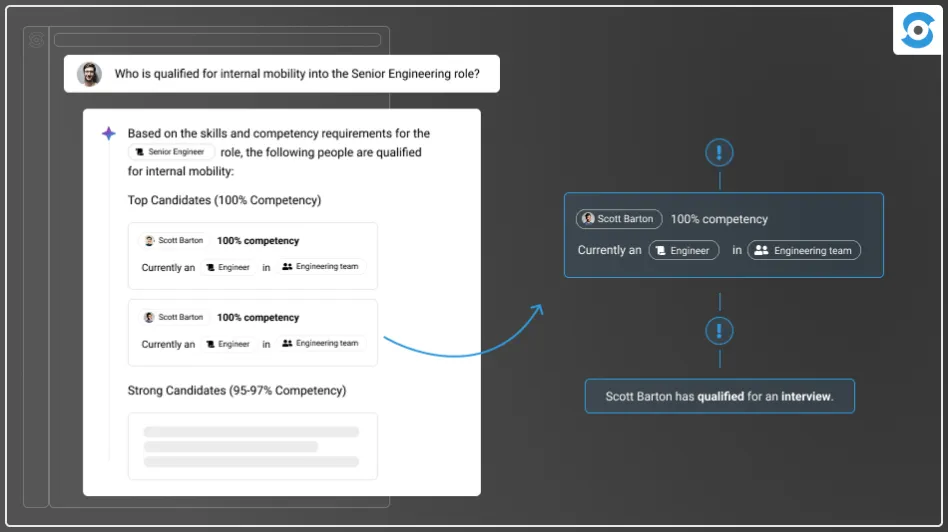
One of the real limitations of traditional people analytics is that it concentrates insight in the hands of a small team with the technical skills to query it. Skills intelligence changes that. Natural language interaction with skills data means that a people leader can ask a question in plain language and get a meaningful answer, without needing to log a request with the analytics team or wait for the next reporting cycle.
This is what democratizing skills data actually looks like in practice. A manager can ask which team members have the certifications needed for an upcoming project. An HR business partner can ask how a department’s skills profile compares to the organization’s strategic priorities. Sam AI is built around this kind of access, making verified skills data useful to everyone who needs it, not just the people who know how to run reports.
AI insights that connect to your business goals automatically
Beyond natural language queries, the more advanced layer of skills intelligence involves automated insight generation. Algorithms and agents working behind the scenes, aligned to specific business goals, surface the insights that matter most without requiring a person to know what question to ask.
This means insights tied to workforce planning, L&D gaps, succession risk, or resource optimization can be generated and delivered proactively, grounded in verified skills data rather than system-generated inferences from job titles or LinkedIn profiles. The result is a skills intelligence platform that functions more like an always-on analyst team than a reporting tool.
One important boundary applies here: AI should be used carefully and sparingly when it comes to the measurement of skills themselves. Verified human assessment, structured and calibrated, must remain at the core of how skills are evaluated. The EU AI Act, which came into force in February 2025, classifies AI use in employment contexts as high-risk, triggering requirements for human oversight, transparency, and bias monitoring. Organizations using AI tools that influence employment decisions should treat this regulatory context seriously, and choose platforms that are built with those principles in mind rather than ones that automate measurement decisions away from human judgment.
Skills data is most powerful when it flows into your existing systems
A skills management and intelligence platform is not a replacement for your existing HR technology. It is a new data layer that makes those investments work harder. The organizations getting the most value from skills data are the ones connecting it to the systems and decisions their teams already rely on.
Deloitte identified this shift in its HR technology research, noting that skills solutions increasingly serve as middleware between incumbent platforms, connecting HCM, LMS, and analytics tools in ways those platforms cannot do for each other. Competency and skill mapping is often the starting point for that integration work, giving organizations a clear picture of what they have before connecting it to what they need.
Your HR platform stays the system of record
Skills data should enrich your HRIS, not replace it. The HR platform remains the single source of truth for people records: employment status, compensation, reporting lines, and all the operational data that HR and payroll depend on. Skills Base integrates with your HRIS to flow verified skills data into individual profiles, adding a capability dimension to the record without disrupting the systems of record your organization already relies on.
This is not a competitive relationship between platforms. It is a complementary one. HR owns the people record. Skills Base owns the capability record. Together, they give a fuller picture of the workforce than either can provide alone.
Connecting verified skill gaps to the right training
The connection between skills data and your LMS is one of the highest-value integrations available to L&D teams. When you know, at a verified level, which skills are below the required proficiency for a given role or team, you can direct training investment precisely rather than broadly. Employees get recommendations for content that closes their actual gaps, not a catalog to browse. L&D teams can measure whether training is working by tracking whether skill levels improve after completion.
This also improves the quality of training content over time. When you can see which courses are moving the needle on skill proficiency and which are not, you have the evidence to build more effective programs. Skills data transforms the LMS from a content library into a closed-loop learning system.
Skills data across people analytics, operations, and beyond
For people analysts, verified skills data is among the most valuable inputs available. Connecting it to your BI tools means skills trends, gap analysis, and capability comparisons can sit alongside headcount, engagement, and performance data in the same dashboards. Skills data becomes the missing layer in your people analytics strategy, the one that tells you not just who you have but what they can do.
Beyond people analytics, skills and certification data has direct operational value in workforce management, field service management, and CRM platforms. Matching the right person with the right verified skills and current certifications to the right job, task, customer, or machine is a real and high-stakes decision in industries from manufacturing and engineering to professional services and healthcare.
An API-first approach means skills data can flow into whichever systems your teams already use for allocation decisions. No new workflows required.
Why a platform built only for skills can go further
There is a reason dedicated skills management and intelligence software exists as its own category. HR platforms, talent suites, and LMS tools often include skills features. Most of them treat skills as a field, not a discipline. The taxonomy gets built once and left to decay. The assessment model is too simple to produce trustworthy data. The reporting is surface-level. And the AI, without a verified data foundation, is generating inferences from noise.
A platform built only for skills makes different trade-offs. It invests in the depth of the taxonomy model, the rigor of the assessment methodology, the quality of the gap analysis, and the integrity of the data that everything else depends on. It is also in a position to handle the complexity that makes skills data hard to maintain at scale: versioning the taxonomy as roles evolve, managing certification expiry, configuring assessment cadences by team, and keeping data current without creating administrative overhead that causes adoption to collapse.
Privacy is part of this too. Skills data is sensitive. Employees are disclosing their capabilities and gaps, often in the context of decisions that affect their careers. How that data is collected, stored, who can see it, and how it is used are not afterthoughts. They are design decisions that affect trust and adoption. A platform focused on skills is in a better position to get those decisions right than one where skills are a secondary concern.
The market is recognizing this. The global skills management software market was valued at $1.25 billion in 2024, with projections pointing to $4.5 billion by 2033. Organizations are not investing in dedicated skills platforms because they are fashionable. They are investing because the alternatives have not delivered the data quality or the organizational trust that effective skills management requires.
If your organization is ready to move beyond skills as a field in a spreadsheet, see what a purpose-built skills management and intelligence platform looks like in practice. The gap between what most organizations have and what is possible is larger than most HR leaders expect.

