Every executive has lived some version of this moment. A competitor moves. A technology shifts. A client relationship that felt permanent suddenly feels fragile. The board convenes. The pressure is immediate and the questions are direct: what do we have, what do we need, and how fast can we move?
At its core, organizational agility is the ability to sense change and respond to it faster than the market punishes you for being slow. Most organizations aspire to it. Few can execute on it. Not because they lack talented people, but because they have no reliable way to see what those people can actually do. Skills sit buried in resumes, locked inside department silos, or captured in annual reviews that are already twelve months out of date by the time anyone reads them.
That gap between the capability you have and the capability you can see is not a minor operational inconvenience. It is a strategic liability. And in a market that rewards speed, it is one you cannot afford to carry.
The disruption test
Think about what happens inside a typical organization when a genuine competitive threat lands. A major competitor launches an AI-native product that directly challenges your core business. The board demands a response. The CTO identifies a capability gap and calls for 40 ML engineers, immediately. Recruiting kicks off an external hiring push. Twelve weeks later, you have hired 18 people at inflated market salaries. Most of them need six months to onboard and reach full productivity. Your competitor is already iterating on version two.
This is not a story about a bad HR process. It is a story about a fundamental visibility problem. Somewhere inside your organization, the capability you needed already existed. But you had no way to find it, validate it, or mobilize it at speed. So you went to the market instead.
The question every executive should be asking is not: can we hire fast enough? It is: do we actually know what we already have?
Here is what that same scenario looks like when you operate with a real-time, verified model of your workforce capabilities. Within 72 hours of the competitive threat emerging, your CHRO runs a skills scan across the entire organization. You discover 34 employees with validated ML and AI capabilities spread across six departments. Most of those skills were acquired through self-directed learning and side projects that never surfaced to leadership.
You redeploy 22 of those people into a rapid-response AI initiative within two weeks. External hiring fills only the genuinely specialized gaps that do not exist internally. You ship a competitive response in half the time, at a fraction of the cost, with people who already understand your systems, your culture, and your customers. Research from talent marketplace analysts shows that internal redeployment costs three to five times less than external hiring and fills roles 20 days faster on average.
What the data says
The case for skills visibility is not anecdotal. Deloitte’s research found that skills-based organizations are 79% more likely to deliver a positive workforce experience and 63% more likely to achieve business results compared to those without a skills-based approach. The World Economic Forum’s Future of Jobs Report 2025 projects that 39% of core workforce skills will be transformed or obsolete by 2030, with 63% of employers identifying skills gaps as their primary barrier to business transformation. And in Deloitte’s 2025 Global Human Capital Trends survey of nearly 10,000 leaders across 93 countries, 85% said organizations need to create more agile ways of organizing work.
The direction is clear. The only variable is whether you have the visibility to act on it.
Why this belongs in the boardroom
Workforce visibility has traditionally been treated as an HR concern. Important, perhaps, but not a strategic priority for the C-suite.
That framing is no longer viable. The speed at which competitive landscapes shift has made organizational workforce agility a core business capability, not a support function. When your ability to respond to disruption depends entirely on how quickly you can identify and mobilize internal expertise, the question of whether you can actually see that expertise becomes a board-level question.
Consider what executives are routinely being asked to do: accelerate product development, enter new markets, absorb acquisitions, navigate regulatory change, respond to AI disruption across virtually every industry vertical. Every one of those challenges has a talent dimension. Every one of them is complicated by the absence of verified, real-time data on what your workforce can actually do.
Mercer’s Global Talent Trends 2026 report found that 98% of executives are planning organizational design changes in the next two years, with 65% expecting to redeploy or reskill 11% to 30% of their workforce due to AI alone. Yet only 30% of leaders rate their organization’s digital agility as high. That gap between recognized need and actual capability is precisely where skills visibility lives.
You cannot build a credible strategic workforce plan on top of annual self-assessments and static org charts. You cannot optimize resource allocation when your understanding of individual capability is based on job titles and tenure. And you cannot reduce hiring costs without knowing, with confidence, that the skills you need are not already sitting inside your own organization. For executives ready to quantify this opportunity, the executive playbook for skills-first ROI lays out a practical framework.
Organizational agility is a data problem
If you ask most leaders how to improve organizational agility, they will talk about culture. Hire curious people. Build flat structures. Encourage experimentation. Those things matter. But agility also has a mechanical requirement: you need to be able to see what you have and move it where it needs to go.
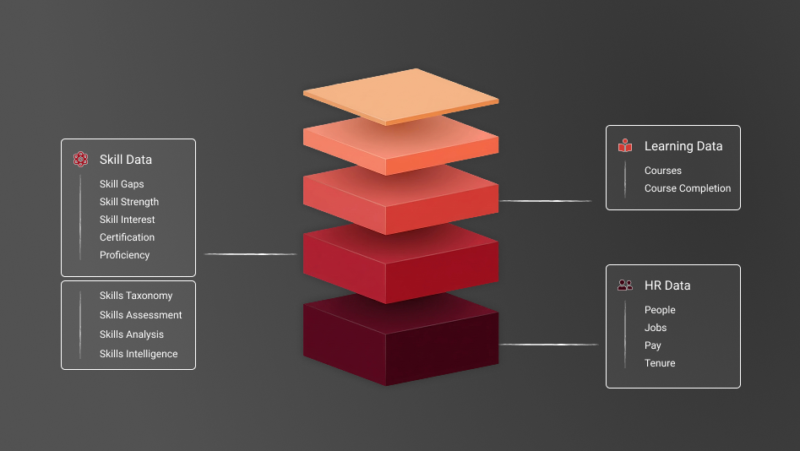
A skills model gives you that mechanical capability. It replaces the guesswork of talent deployment with verified data. It tells you not just that someone has a skill on their resume, but what their actual proficiency level is, whether they are currently applying that skill, and whether they are interested in doing more of it. That distinction matters enormously when you are making redeployment decisions under pressure.
It also creates a feedback loop that compounds over time. When you know which skills exist in your organization and where capability gaps are forming, you can get ahead of disruption rather than just react to it. You can invest in the right learning and development initiatives before the gap becomes critical. You can identify the internal talent most likely to grow into future leadership roles. You can build a workforce that is not just strong today but positioned for the conditions you are likely to face in three years.
Yet most organizations are still in the early stages of this shift. Mercer’s 2025/2026 Skills Snapshot Survey found that only 38% of organizations maintain a single, enterprise-wide skills library, up from 30% in 2023. Progress is happening, but the majority still lack unified visibility into what their people can do. For a deeper exploration of how to close that gap, the definitive guide to skills intelligence covers the full landscape.
The organizations that win on agility are not the ones with the most talent. They are the ones who can see it, trust it, and move it.
What becomes possible with verified skills data
he word “data” gets used loosely when it comes to talent. Most organizations have plenty of talent data. What they lack is talent data they can act on. The difference comes down to verification and structure.
A structured skills taxonomy built around your organization’s specific capabilities gives you a consistent language for capability across every department, team, and geography. Verification, through manager assessment and proficiency benchmarking, ensures that the data reflects reality rather than self-reported optimism.
When you combine structure with verification, several things become possible that were not before:
- Resource allocation shifts from intuition to evidence. You find the right expert for the right initiative in hours, not weeks.
- Strategic workforce planning becomes proactive. You can model the capability implications of a strategic pivot before you commit to it.
- L&D investment becomes targeted. You stop spending on programs that address skills the organization already has, and start addressing the gaps that actually threaten execution.
- Internal mobility becomes a genuine talent strategy. Employees see clear pathways. Leaders see a broader pool of deployment options. The organization retains expertise it would otherwise lose.
- Hiring becomes more precise and less expensive. You know exactly what you need externally because you know exactly what you already have internally.
The compounding cost of inaction
None of this requires a multi-year transformation program. The technology exists to build a dynamic, verified model of your workforce capabilities without the kind of implementation friction that has historically made HR technology initiatives so difficult to justify.
What it does require is a decision to treat workforce visibility as a strategic priority rather than an administrative one. That decision starts at the top.
The organizations that have already made that shift are scanning their internal capabilities continuously. They are connecting skills data to strategic objectives in real time. They are moving faster, spending less on external hiring, and building the kind of organizational agility and resilience that compounds over time.
The organizations that have not made that shift are still finding out what they have by calling a meeting. They are still running emergency hiring processes that cost more and take longer than anyone wants to admit. They are still losing the disruption test, not because they lack talent, but because they cannot see it.
Organizational agility is not a culture initiative. It starts with knowing what your people can do.
Skills Base gives executives and their leadership teams the verified, real-time view of workforce capabilities they need to make faster, smarter talent decisions. From rapid redeployment to strategic workforce planning, we give you the visibility to manage today and the insight to plan for tomorrow.