


Most organizations operate on a “hunch-based” model of talent management. You have a project that requires advanced Python skills. You ask around. A manager says, “I think Sarah knows Python.” You check her LinkedIn. It lists Python. You put Sarah on the project.
Two weeks later, the project is stalled. Sarah knows Python syntax, but she cannot architect the data pipeline you need. She has familiarity. You needed mastery.
This scenario plays out in every department, every day. It costs businesses millions in delayed projects, bad hires, and burnt-out employees. The root cause is a fundamental misunderstanding of proficiency.
According to Gartner’s recent research, 41% of HR leaders agree their workforce lacks required skills, yet they lack the data to fix it. We need to stop treating skills as binary checkboxes. “Yes” or “No” is not data. It is a guess. To build a resilient organization, you must define, measure, and track proficiency with scientific precision.
Defining Proficiency
Proficiency is the depth of capability. It is the distance between “I have heard of this” and “I can teach this to others.”
In a binary world, a junior developer who just completed a bootcamp and a principal architect with ten years of experience both check the box for “Java.” In the real world, their utility to your organization is vastly different.
True proficiency comprises three dimensions:
- Knowledge: The theoretical understanding of a subject.
- Experience: The practical application of that knowledge over time.
- Autonomy: The ability to execute tasks without supervision or guidance.
When we track proficiency, we measure where an individual sits on this spectrum. We move from the vague to the concrete. We stop asking “Can you do this?” and start asking “How well can you do this, in what context, and with how much support?”
This distinction changes the conversation. It transforms “talent” from a nebulous concept into a measurable asset class.
The Context Trap: Why Role Design Matters
Measuring proficiency in a vacuum is useless. A score of “3 out of 5” means nothing without context.
This is where traditional HR systems fail. They treat skills as absolute values. But in a business, skills are relative. An absolute proficiency level of “3” (Intermediate) in Public Speaking might be excellent for a Backend Engineer. That same level is a catastrophic failure for a VP of Sales.
You cannot evaluate talent without evaluating the requirement. You need a target.
The Proficiency Nuance: Same Skill, Different Level
This brings us to the concept of Skill and Competency Mapping. One of the biggest mistakes organizations make is creating different skill names for different levels of seniority. They might create “Junior Java” and “Senior Java” as two separate skills.
This is wrong. It breaks your data model and makes reporting impossible.
In Skills Base, we use a cleaner, more logical approach. You use the same skill entity (e.g., “Project Management”) across the entire organization. However, you map it to different roles with different Proficiency Targets.
Let’s look at a practical example:
The Skill: Project Management
- The Junior Role: You map this skill to a “Junior Project Coordinator.” For them, you set the target at Level 2 (Novice). They need to understand the basics, update schedules, and take notes. If they hit a 2, they are succeeding.
- The Senior Role: You map the exact same skill to a “Senior Program Director.” For them, you set the target at Level 5 (Expert). They need to manage complex risks, handle stakeholder conflict, and mentor others.
This structure allows you to see the progression path clearly. It shows the Junior Coordinator exactly what they need to learn to become a Senior Director. They don’t need to learn a “new” skill; they need to deepen their proficiency in the existing one.
This is critical because LinkedIn Learning reports that skill sets for jobs have changed by 25% since 2015 and are expected to change by 65% by 2030. If your data model is cluttered with duplicate skills, you will never keep up.
How Skills Base Tracks Proficiency: The Competency Metric
We built Skills Base to kill the static spreadsheet and replace it with a dynamic data model. We handle proficiency through a specific metric we call Competency.
Competency is not a raw score. It is a percentage. It represents the relationship between an employee’s actual proficiency and the target proficiency required for their role, team, or specific assignment.
We calculate it simply:
Actual Score / Target Score = Competency Percentage.
Using our previous example:
- Scenario A: The Junior Coordinator (Target: 2) assesses at a Level 2. Their Competency is 100%. They are fully competent for their current seat.
- Scenario B: The Senior Director (Target: 5) assesses at a Level 2. Their Competency is 40%. They are severely under-skilled for their seat.
Same raw score. Vastly different business implication.
If they hold a proficiency of 5 (Expert) but the target is 4, they are 125% competent. You instantly see an over-qualification, which triggers a different conversation about retention and internal mobility.
The Power of Granular Targets
We allow you to set these targets at multiple levels because organizations are complex.
- Role Level: This is your baseline. Every “Senior Developer” needs a baseline of technical skills. We map these once, and they apply to everyone in that seat.
- Team Level: Specific teams have unique needs. A “Senior Developer” on the AI team needs different targets than a “Senior Developer” on the Web team. We layer these targets to reflect reality.
- Individual Level: Sometimes, you need to be super granular and specific such as in the situation of an individual taking over in a secondment capacity or targeted for leadership promotion. You set personal targets that exceed their current role to prepare them for the future. It’s worth noting that applying skill targets at the individual level becomes an administration nightmare, and we advise against it.
By tracking Competency as a percentage relative to these targets, we normalize the data. We allow you to compare a Junior Designer and a Senior Architect on the same graph. You are not comparing their raw skills; you are comparing how well they fit the expectations you have set for them.
Visualizing the Truth: Reporting on Proficiency
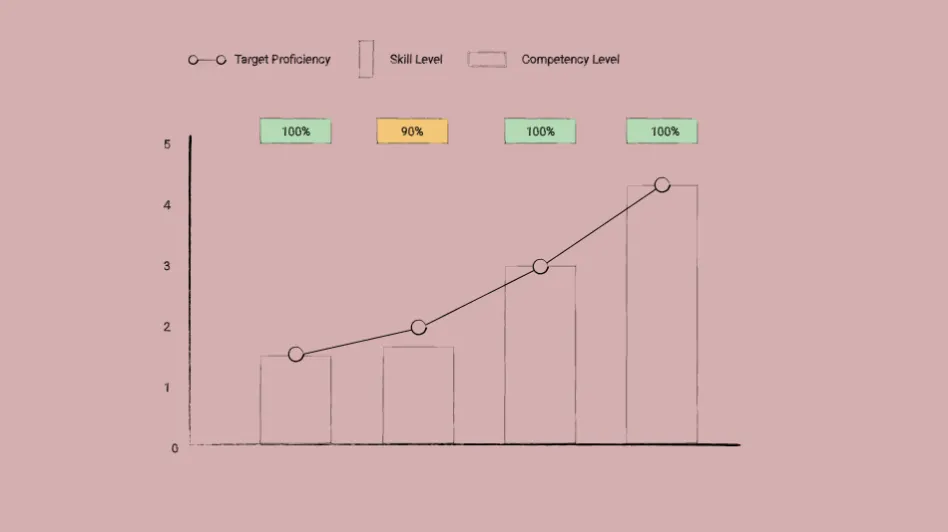
Data is useless if it sits in a database. You need to see it to act on it. We provide two primary lenses to view proficiency data: the Competency Matrix and the Proficiency Gap Graph.
The Competency Matrix
The Competency Matrix is the antidote to the quarterly performance review. It is a real-time, visual heatmap of your team’s capability.
Imagine a grid. Down the left side, you have your employees. Across the top, you have the critical skills for their department.
In the cells, you do not just see numbers. You see color-coded indicators of Competency.
- Green: The employee meets or exceeds the target.
- Red/Orange: The employee is below the target.
- Grey: The skill is not required for this person.
One glance at this matrix tells you the health of your team.

If you see a vertical column of red under “Cloud Security,” you have a systemic risk. Your entire team lacks a critical skill. You do not need to fire anyone; you need to book training. You have diagnosed a group-level deficiency that no individual performance review would ever catch.
If you see a horizontal row of red for a specific employee, you have a performance issue. This person is not meeting the requirements of their seat. You now have the objective data to support a performance improvement plan or a role change.
The Competency Matrix removes the emotion from talent management. We stop arguing about opinions and start discussing facts.
Proficiency Gap Graphs
While the Matrix shows you the “now,” the Gap Graph shows you the “work.”
Gap analysis is the process of identifying the delta between where you are and where you need to be. We visualize this clearly. We plot the Target Level (the expectation) against the Actual Level (the reality) for every skill.

Visualizing these gaps drives three critical business functions:
Precision Learning & Development (L&D)
Most L&D budgets are wasted on “spray and pray” training. Companies buy a generic library of courses and hope people watch them. Deloitte’s 2024 Global Human Capital Trends report highlights that organizations that prioritize human sustainability—including skills development—are nearly twice as likely to achieve positive business outcomes.
With Gap Graphs, you stop guessing. You see exactly where the deficits are. You assign training specifically to close those gaps. If an employee has a gap in “Negotiation,” you assign a negotiation workshop. You do not waste their time with general communication training. You measure the ROI of training by watching the gap shrink over time.
Strategic Hiring
We often hire for the wrong things because we don’t know what we lack. A manager says, “We need another senior engineer.”
You look at the Gap Graph for the team. You realize the team is actually fully competent in coding but has a massive gap in “Project Management” and “Stakeholder Communication.”
You don’t need another coder. You need a Technical Lead or a Project Manager. The data changed the hiring requisition. You saved the company from making an expensive, redundant hire. Considering the cost of a bad hire can range from 30% of the first-year salary to much higher for executives, this insight pays for the platform immediately.
Risk Mitigation
Proficiency gaps are business risks. In industries like manufacturing, healthcare, or aviation, a proficiency gap is a compliance violation or a safety hazard.
We allow you to report on these gaps instantly. You can prove to an auditor that you identified a gap, assigned training, and verified the new proficiency level. You turn compliance from a scramble into a system.
The Cultural Shift: From Judgment to Development
Tracking proficiency often scares employees. They worry it will be used against them. “If I score low, will I be fired?”
You must control this narrative. We build Skills Base to empower employees, not to police them.
When you track proficiency relative to a target, you give employees a roadmap. You tell them, “This is what success looks like in your role.” Most employees do not know this. They guess what their boss wants.
By making the targets visible, you democratize career growth. An employee can look at the “Principal Engineer” role, see the proficiency targets, compare them to their current profile, and see exactly what they need to learn to get promoted.
They stop asking, “How do I get ahead?” and start working on the specific skills that bridge the gap. You shift the culture from one of judgment (“You aren’t good enough”) to one of development (“Here is how you get to the next level”).
The ROI of Truth
The spreadsheet is dead. The “hunch” is a liability.
Organizations that win in the next decade will be the ones that treat talent data with the same rigor they treat financial data. You would not run your finance department on guesses. You cannot run your workforce on them either.
We provide the structure to define proficiency. We provide the mechanism to track it as Competency. We provide the visualizations to expose the gaps.
The result is a digital model of your workforce that reflects reality. You make better hires. You deploy people to the right projects. You train for impact. You retain your best people by showing them a clear path forward.
Proficiency is not a buzzword. It is the atomic unit of your business execution. Measure it. Track it. Use it.

