Your organization is full of potential. You have hired smart, capable people who want to do good work. They want to grow, they want to contribute to the mission, and they want to feel that their unique talents are recognized and utilized.
We live in an era where we have more data than ever before to help us achieve these goals. We have dashboards for customer sentiment, real-time analytics for sales performance, and granular tracking for operational efficiency. We use this data to make smarter, faster decisions that drive our businesses forward.
Yet, when it comes to our most valuable asset—our people—we often operate on instinct. We rely on intuition and conversation to guide complex career trajectories and critical business needs. While the intention is always good, the lack of precision creates a barrier. We struggle to connect the individual’s ambition with the organization’s strategy because we lack a shared language to describe what our people can actually do.
This is why leading enterprises are shifting to become Skills-Based Organizations. They recognize that the old job-based structures are too rigid, and they need a fluid, data-driven approach to talent.
The solution isn’t to have more meetings. The solution is to make the meetings we already have more powerful. We need to bring the same level of clarity and insight to our talent conversations that we bring to our financial reviews.
The Strategic Heartbeat: The One-on-One
The one-on-one is one of the most critical touchpoints in your organization. It is the dedicated space where strategy translates into execution. It is where a manager and an employee align on goals, clear obstacles, and build the trust required for high performance.
When executed well, this meeting is the engine of your culture. It is where an employee goes from feeling like a cog in a machine to feeling like a valued partner in a shared mission. It is where a manager transitions from a taskmaster to a coach.
However, even the best managers struggle to maximize this time because they are fighting against subjectivity. Without a clear view of capabilities, conversations often drift. We rely on recent memory—what happened last week—rather than a holistic view of an employee’s proficiency and growth over time. We rely on “feelings” about who is ready for a challenge, rather than evidence of who has the necessary skills.
This inefficiency has a cost. As Harvard Business Review notes, we need to stop the meeting madness where valuable time is burned without clear outcomes. If the one-on-one is the single most expensive recurring meeting you host, you need to ensure it delivers a return on investment.
This is where verified skills data transforms the dynamic. It acts as a neutral, objective foundation for the conversation. It turns the one-on-one from a subjective check-in into a strategic collaboration.
Moving from "I Think" to "The Data Shows"
The modern workforce deserves more than “I think.”
Consider a traditional career development conversation. A manager and a direct report sit down to discuss the next step. The manager supports the employee but feels they aren’t quite ready for a promotion. They might say, “You need to be more strategic,” or “I need to see you take more ownership.”
While well-intentioned, these statements are vague. They are open to interpretation. The employee leaves unsure of what specific actions to take, and the manager leaves hoping the message landed. This is often due to the “Idiosyncratic Rater Effect”—a phenomenon described in the Feedback Fallacy—where our rating of others reveals more about us than it does about them.
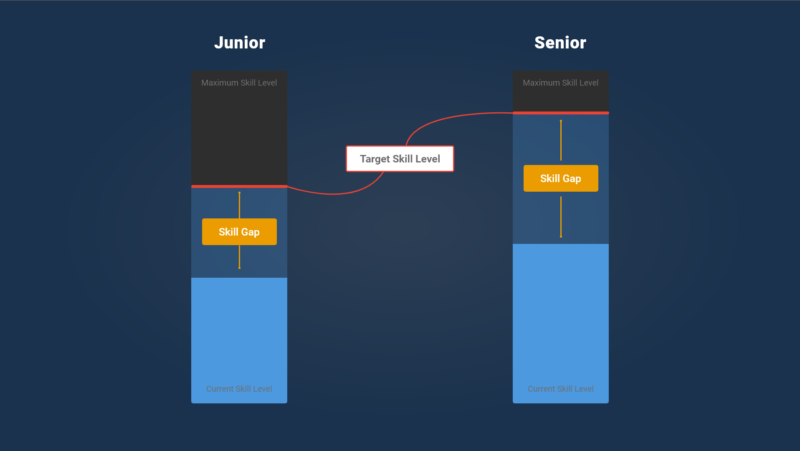
Now, imagine that same conversation anchored in Skills Base. The manager pulls up the employee’s skills profile. They look at the gap between the target role, and overlay the employee’s current verified skills.
The path forward becomes instantly clear. The data shows the employee has mastered Java and System Architecture (verified by technical assessments), but the target role requires a Level 4 proficiency in Stakeholder Management and Project Scoping, where the employee is currently at a Level 2.
Now the conversation is actionable. The manager says, “Your technical foundation is incredibly strong. To get you to the next level, let’s focus specifically on Project Scoping. Let’s find a project next quarter where you can lead the scoping phase and we can verify that skill growth.”
The ambiguity vanishes. The goal is clear, the metric is objective, and the path to success is defined. The one-on-one becomes a session for problem-solving and planning, rather than a debate about perception.
Verification Builds Confidence
The power of this approach lies in the “Verified” aspect of the data. Self-assessment is a valuable starting point—it tells us how employees see themselves—but verification adds the layer of trust required for critical talent decisions.
We know that human beings are not always the best judges of their own competence. Some underestimate their abilities, suffering from imposter syndrome. Others overestimate them, unaware of the depth required for true mastery, a cognitive bias known as the Dunning-Kruger Effect.
Skills Base solves this through a proven measurement methodology the structured subjective approach. We allow you to confirm proficiency with precision, whether through manager validation, or integration with formal certifications.
When you bring verified data into the room, you validate the employee’s hard work. It is no longer just a claim; it is a confirmed fact.
Real-Life Example: The Quiet Expert
Let’s look at Sarah. Sarah is a data analyst. She is introverted, diligent, and consistently delivers high-quality work. She doesn’t often speak up in meetings to broadcast her achievements.
Her manager, David, values Sarah as a steady hand. However, he manages a large team and isn’t fully aware of the depth of her technical capabilities beyond her daily tasks.
Then David’s organization implements Skills Base. As part of a department-wide initiative, Sarah updates her profile and verifies her skills.
David pulls up the team-based skills matrix. He sees a sea of data, but one datapoint jumps out. Sarah has a verified Level 5 proficiency in Python and Machine Learning Models. David hadn’t realized she possessed such advanced capabilities in this area; he thought her primary focus was SQL. It turns out Sarah had been upskilling on her own time and had passed a rigorous certification.
The next one-on-one is radically different. David starts by acknowledging this discovery. “I was looking at your skills profile and saw you are verified in Machine Learning. We have a predictive modeling project coming up that I was worried about staffing. I didn’t realize we had this expert capability right here. Would you be interested in leading it?”
Sarah feels seen. She feels valued not just for what she does every day, but for what she knows. The organization taps into a hidden resource, and Sarah gets a career-defining opportunity. Without verified data, this connection likely never happens.
Empowering Employee Agency
This approach is not just about management having better visibility; it is about giving employees agency over their own careers.
Employees today are eager to grow. According to LinkedIn’s Workplace Learning Report, opportunities for career growth and learning are top priorities for the modern workforce. When skills data is transparent and accessible, it empowers them to drive the agenda of the one-on-one.
They can use the “Map” feature to see exactly how their skills align with different roles across the business. They can say, “I see that our team has a gap in Cloud Security. I have a strong interest in this area. If I take this course and verify my skill, can I take on the security audit next quarter?”
This is the “Internal Career Mobility” use case in action. The employee uses the organization’s own data to build a business case for their development. They move from waiting for permission to executing a plan that aligns their personal interests with the business needs.
Real-Life Example: The Role Realignment
Consider Marcus. Marcus is a top-tier salesperson who consistently exceeds his targets. Naturally, he assumes his next step is “Sales Manager.”
His director, Elena, wants to support him, but she knows the manager role requires a heavy focus on administration and coaching—areas Marcus has never shown interest in.
Elena uses Skills Base to facilitate the conversation. She pulls up the skill profile for “Sales Manager.” It prioritizes Coaching, Pipeline Forecasting, and Conflict Resolution.
She asks Marcus to self-assess against these skills. Marcus is honest. He rates himself low on Coaching. He admits he dislikes administrative tasks, so Forecasting is a weakness.
In the one-on-one, they review the data together. Elena highlights the disconnect—not as a criticism, but as a structural reality. “You excel at Negotiation and Client Strategy. The manager role requires you to trade those activities for administrative ones where you have less interest.”
Marcus sees the data and agrees. Elena proposes an alternative path: a “Principal Sales Lead” role. “We map this role to your strengths. You handle the most complex accounts, you continue to drive revenue, but you don’t take on the people management burden.”
Marcus feels understood and relieved. The data helped them find a solution that keeps him engaged and doing what he does best.
Skills Lens: Intelligence on Demand
Managers are busy. They do not always have the time to analyze complex data sets before every meeting. This is where Skills Intelligence steps in.
Skills Lens acts as an “Agentic On-Demand Analyst Team” for the manager. It provides instant context.
Before a meeting, a manager can use the Risk Intelligence Agent to ask: “Skills Lens, identify any critical risks where this employee is the single point of failure.”
Skills Lens might flag that this employee is the only person in the region verified in Legacy System Maintenance. This insight immediately elevates the strategic value of the one-on-one. The conversation naturally shifts to succession planning and knowledge transfer. “You are the only expert we have on the legacy system. That makes you incredibly valuable, but it also puts a lot of pressure on you. Let’s set a goal for you to mentor a junior colleague so you aren’t the only one carrying this load.”
The manager is proactive. The employee feels supported. The business reduces risk.
From Review to Preview
The traditional performance review looks backward. It dissects what happened in the past. The skills-based one-on-one looks forward. It models what is possible.
When you have a dynamic digital model of your workforce, you stop driving while looking in the rearview mirror. You align talent to future opportunities. If the company strategy shifts toward AI integration, the one-on-one adapts instantly. You can look at the employee’s “Interest” data—a unique attribute in Skills Base that tracks passion, not just proficiency.
“I see you flagged an interest in Generative AI. The company is pivoting that way. Let’s get you verified on the new toolset so you can be part of the pilot team.”
You align the individual’s trajectory with the company’s velocity. You create a culture where the employee knows their skills are seen, valued, and utilized.
The Bottom Line
Your people are professional, intelligent, and capable. They do not need micromanagement; they need clarity. They need to know where they stand and where they can go.
When you bring verified skills data into the one-on-one, you respect their intelligence. You give them a clear view of their development. You give your managers the tools to be true coaches rather than just supervisors.
You move from “I think” to “I know.”
That is how you build a high-performance culture. You don’t build it with speeches. You build it one data-driven conversation at a time.