


The spreadsheet is the duct tape of the modern enterprise. It is flexible, accessible, and virtually free. When a problem arises that doesn’t fit neatly into a major software suite, we open a new workbook. We create columns. We add rows. We feel a sense of immediate control.
For finance, this works. Numbers are static. A dollar is a dollar. But for skills management, the spreadsheet is a trap.
You cannot capture the complexity of human capability in a two-dimensional grid. Skills are not static integers; they are living, breathing, decaying, and evolving attributes. They require context. They require verification. They require connection to the broader business strategy.
Yet, organizations continue to run their most critical asset—their talent—on “.xlsx” files saved to local drives. We call this the “Illusion of Control.” You have the data, but you do not have the truth. Research indicates that 88% of spreadsheets contain errors, meaning your “truth” is likely flawed from the start.
This is why the manual matrix is failing you, and why you must move to a dynamic data model to survive the talent demands of the modern market.
The Decay of Static Data
The moment you save a skills matrix spreadsheet, it begins to die. It is a snapshot of a specific moment in time.
Consider the typical workflow. An HR leader asks department heads to update their team’s skills. The emails go out. The managers spend three days chasing employees. They fill in the cells. They send the files back. The HR leader spends another two days merging five different workbooks into a master file.
By the time that master file is ready for analysis, the data is two weeks old. In a fast-moving organization, that latency is fatal.
Employees complete new certifications. Projects shift. People leave. New hires arrive. The spreadsheet captures none of this in real time. You base strategic decisions on historical artifacts, not current reality.
True skills intelligence requires a living system. It requires a platform where the data updates as the work happens. It requires integration with the systems your employees use every day. When a certification is earned, the record should update instantly. When a project is completed, the skills acquired should be captured immediately.
The Taxonomy Nightmare
Spreadsheets lack structural integrity. They rely on free-text entry, which is the enemy of data hygiene.
Ask five different managers to record a specific software skill. Manager A types “Javascript.” Manager B types “Java Script.” Manager C types “JS.” Manager D types “Front End Dev.”
To a spreadsheet, these are four different skills. When you try to run a report to find your Javascript experts, you miss half of them. You cannot aggregate, filter, or analyze data that lacks a unified language.
This is where a structured skills management platform changes the game. You build a data model of your organization’s capabilities. You define the skills that define you. You create a bespoke taxonomy that reflects your unique language, competitive edge, and operational needs.
When you control the taxonomy, you control the insights. You ensure that “Project Management” means the same thing in your London office as it does in your Sydney office. You create a common currency for talent that flows across borders and departments.
The Evolution of the Skills Matrix
This is where the difference becomes visible—literally.
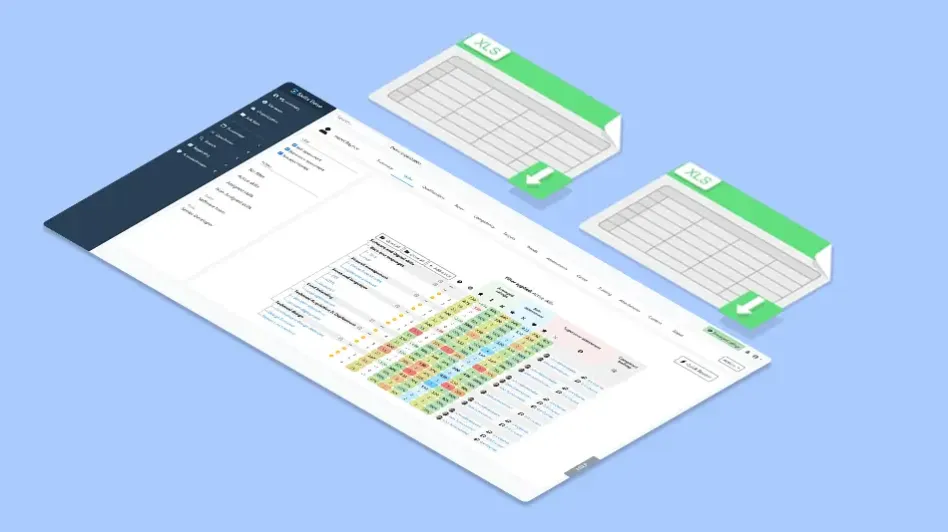
In a spreadsheet, a skills matrix is a wall of text. It is a dense grid of names and checkboxes that requires deep concentration to decipher. If you want to compare two teams, you have to scroll. If you want to spot a gap, you have to hunt for the empty cells. It is passive data presentation.
A modern platform transforms this flat grid into a Dynamic Skills Matrix.
We move from data entry to data visualization. You generate real-time, automated skill and competency matrices that allow you to instantly spot team strengths and critical gaps at a glance.
- Visualize Side-by-Side: Select any combination of individuals—a project squad, a department, or potential candidates—and view their capabilities in a heat map.
- Spot the Gaps: High proficiency lights up in green; gaps glare in red. You do not need to analyze the data; the visual tells the story instantly.
- Team Composition: You are building a tiger team for a new client. You immediately see that while you have plenty of engineering talent, the team completely lacks the “Client Negotiation” skill. You solve the problem before the project starts.
The dynamic skills matrix changes the conversation from “Do we have this data?” to “What does this data tell us?” It turns a list of names into a strategic command center.
Automation and Workflows: The Connected Ecosystem
A spreadsheet is an island. It does not talk to your other systems. This isolation creates administrative drag and data silos.
To drive true agility, you must automate the flow of data. You need a connected ecosystem where your skills intelligence engine powers—and is powered by—your existing tools. We replace manual “copy-paste” tasks with intelligent workflows.
Sync Core Workforce Data with HRIS Stop manually adding new hires to your skills matrix. Stop manually removing leavers. We integrate directly with your HRIS (Human Resources Information System). When you add a new employee to your HR system, they appear instantly in Skills Base, assigned to the correct team and role. When an employee leaves, their access is revoked automatically. This ensures your skills data always mirrors your organizational reality, without a single manual keystroke.
Bridge the Gap with LMS Integration
Identifying a skill gap is only half the battle. Closing it is the goal. We connect your skills data directly to your Learning Management System (LMS). When a manager identifies a gap in “Data Security,” the system doesn’t just record it; it recommends the specific course from your LMS to fix it. You create a seamless loop: assess the skill, find the gap, deploy the training, and re-assess the capability.
Deep Visualization with BI Tools
Your C-Suite lives in PowerBI, Tableau, or Looker. They do not want to log into another tool to see a report. We liberate your data. You can pipe your raw skills and interest data directly into your Business Intelligence tools. This allows you to mash up skills data with other business metrics. Compare “Sales Skills Proficiency” against “Revenue Per Rep.” Compare “Customer Service Certification” against “NPS Scores.” This is where you prove the ROI of talent investment.
Automate the "Nudge": Assessment Intervals
Data freshness is critical. But chasing employees to update their profiles is a full-time job. We automate the chase. You set the cadence—quarterly, bi-annually, or yearly. The system triggers personalized notifications to employees and managers when it is time to review their skills. It tracks completion rates and escalates to managers if deadlines are missed. You get fresh data; HR gets their time back.
The Compliance Safety Net
In regulated industries, an expired certificate is a business risk. We replace the calendar reminder with an automated compliance engine. The system tracks every expiration date for every license.
The Verification Gap
Who says that employee is an “Expert” in Data Analysis?
In a spreadsheet, the source of truth is often ambiguous. Did the employee rate themselves? Did a manager guess? Is it based on a project from three years ago? A cell turning green because someone typed a “4” does not make it true.
Without a structured workflow, skills data is little more than opinion. However, you do not need to subject your workforce to endless exams to get accurate data. We advocate for a Structured Subjective approach.
This method balances speed with rigor, moving you away from “guessing” and toward “validating.”
- Define the Criteria First, you remove ambiguity. You replace a generic “1-5” scale with defined behavioral indicators. A “Level 3” must mean the same thing to a Junior Engineer as it does to a Senior Director.
- The Self-Assessment You start with the employee. They know their capabilities best. By allowing them to rate themselves against defined criteria, you drive engagement and capture data rapidly. It changes the dynamic from “surveillance” to “empowerment.”
- The Supervisor Validation This is the critical control point. The manager reviews the self-assessment. If the employee rates themselves a “4” but the manager sees them as a “3,” the platform flags the disparity.
This disparity is not a failure; it is an insight. It forces a conversation. Is the employee overconfident? Or has the manager missed a hidden talent? By resolving these gaps through discussion, you end up with a verified rating that both parties agree on—data you can actually trust.
The "So What?" Problem
The ultimate failure of the spreadsheet is its inability to answer the question: “So what?”
You have a grid of names and numbers. You can see who has what skill. But you cannot easily see the insights buried within that data.
- Where is our biggest risk of attrition?
- Which department has the most severe skills gap?
- Who is the best internal candidate for this new role?
Spreadsheets are passive. They wait for you to ask the questions.
We build platforms that act as agents. We use AI-powered skills intelligence—our Skills Lens technology—to proactively surface insights.
Imagine a system that learns your business goals. You tell it you want to expand into a new market. The system analyzes your current workforce and tells you: “You are 80% ready, but you lack these three critical regulatory certifications. Here are five employees who are strong candidates to be upskilled.”
This is the shift from “Skills Management” to “Skills Intelligence.” You stop staring at rows and columns and start looking at dynamic visuals that show you exactly where to act. Deloitte’s research shows that organizations taking this skills-based approach are 98% more likely to retain high performers and 57% more likely to anticipate change effectively.
From Static to Strategic
The transition from spreadsheet to platform is a maturity curve. It is the realization that talent data is as important as financial data.
You would not run your company’s finances on a shared spreadsheet. You would not manage your customer relationships on a notepad. Why are you managing your workforce capability on a tool built for accounting?
We are in a new era of workforce planning. The pace of technological change means skills become obsolete faster than ever before. The “half-life” of a learned skill is shrinking. To stay competitive, you must be able to identify gaps, deploy resources, and upskill teams with speed and precision. You need a system that is:
- Structured: A defined taxonomy that creates a shared language.
- Contextual: Data that understands your roles, your teams, and your goals.
- Insightful: AI that tells you what the data means.
- Connected: Integrated into the flow of work.
Spreadsheets served a purpose. They were a bridge. But the bridge is crumbling under the weight of modern complexity. It is time to stop cataloging your people and start modeling your intelligence.
It is time to put the spreadsheet away and build a digital model of your workforce that is as dynamic as the people within it.

